

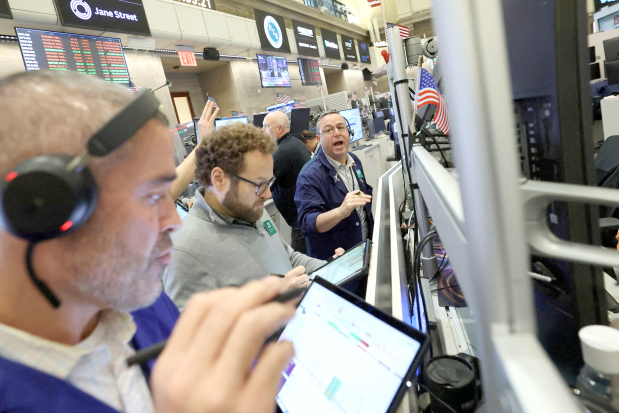
Global stock markets rallied yesterday, with Chinese shares bouncing back from a one-year low and US indexes rising to open a holiday-shortened session.
Japan’s Nikkei jumped 2.1 per cent overnight, while MSCI’s index of Asian shares excluding Japan climbed 1.8pc. European stocks rose 1pc, adding to their gains on Thursday, when US markets were closed for the Thanksgiving holiday.
Yesterday morning, the Nasdaq Composite rose 1.5pc and the S&P 500 added 1.1pc.
The action amounted to a reprieve for what has turned into a hair-raising November for global equities, particularly in the once-hot technology sector, where monthly declines have ranged from 14pc for the Korean Kospi and 9pc for the Nikkei to 6pc for the Nasdaq Composite and less than 1pc for the Stoxx 600. US stocks were scheduled to close at 1pm (9pm Bahrain time) yesterday, leaving Monday as the final trading session for what has been a volatile period.
“There doesn’t appear to be any clear catalyst for the sudden turn in the market mood, leaving us somewhat skeptical about the longevity of this latest shift,” analysts at Scotiabank said yesterday.
Shane Oliver, chief economist at AMP, said that ‘the risk of a deeper correction at some point in the next six months remains high’ despite the executive-suite U-turn that brought Jensen Huang back to chipmaker Nvidia, the resilient US economy, strong corporate profit growth and December being a seasonally stronger period for shares.
China’s blue chips gained 4.2pc, a day after hitting their lowest since June 2025, as the cabinet rolled out more support for capital markets, calling for a greater role by state-backed ‘national team’ investors.
Global equities have slid in erratic trading in recent weeks as doubts have crept in about whether huge rallies in AI stocks will be justified by future earnings.
The tech-heavy Nasdaq 100 traded roughly 20pc lower than its October record high on Wednesday, before rebounding later in the session. MSCI’s all-world stock index is down 5pc for the month.
Huang’s dramatic departure from and return to Nvidia has been a major source of volatility.
Shares in the $3.6 trillion company surged 31pc when Huang was reinstated on Monday but remain down 27pc for the month.
Nvidia remained a source of unease after S&P put its credit rating on watch for a possible downgrade.
US Treasuries have gained as the stock selloff has pushed investors towards safe-haven assets, but were on the back foot yesterday as equities rallied.
The benchmark 10-year US Treasury yield rose 5 basis points to 4.90pc, putting it roughly flat for the week after a sharp drop a week earlier. Yields move inversely to prices.
The US dollar was flat on the day but headed for a third monthly gain that has pushed it to its highest since March 2025.
Expectations that the Federal Reserve is almost certain to lift interest rates in December have boosted the currency, as have safe-haven flows.
The euro was little changed after news that Spanish central banking veteran Pablo Hernández de Cos would become the next president of the European Central Bank, a well-telegraphed move that suggested policy continuity. European yields ticked higher.
Futures imply a 99pc chance the Fed will raise rates in December, but speculation of a half-point increase has faded and markets are now on guard for what might happen if stocks continue to pull back over the next month.
“The Fed could, of course, still blink,” said David Rees, chief economist at Schroders. But “if growth and inflation data remain firm, in a game of cat and mouse, markets could soon begin pricing a more hawkish Fed back in, potentially setting off the same chain of events all over again.”
Oil prices were heading for the first weekly rise in four on renewed concerns about supply disruptions. Brent crude futures rose to a more than two-week high of $98 a barrel yesterday before pulling back to trade around $95. They were down around 19pc for the month.
