

MORE than half of young Arabs in the region, including Bahrain, say drugs are easy to obtain in their home country, according to a new survey.
This is one of the most disturbing findings of the 2019 Arab Youth Survey, which is based on 3,300 face-to-face interviews with young Arab nationals aged 18 to 24 from 15 states in the Middle East and North Africa.
For 11 years, the annual survey has presented evidence-based insights into the attitudes of Arab youth, providing public and private sector organisations with data and analysis to make effective decisions and policies.
The study is the largest of its kind of the region’s demographic, covering GCC countries (excluding Qatar), North Africa (Algeria, Egypt, Libya, Morocco and Tunisia), the Levant (Iraq, Jordan, Lebanon and the Palestinian Territories) and Yemen.
Two hundred respondents from Bahrain contributed to the survey released by Dubai-based public relations firm ASDA’A BCW (Burson Cohn & Wolfe).
“More than half (57 per cent) of young Arabs believe that drug use is on the rise in their country, while merely 18pc say drug use is declining,” said the survey.
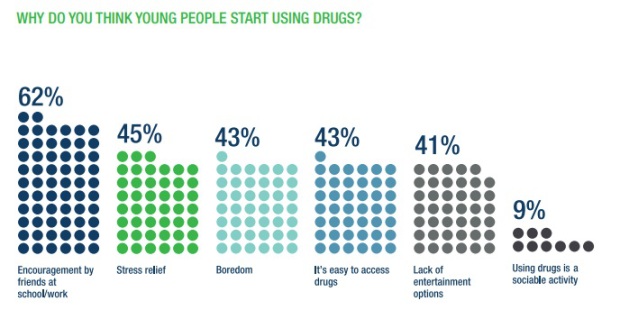
(The top five reasons why youth in the region start using drugs as stated in the survey)
Respondents gave peer pressure as the top reason for young people to start using drugs, with 62pc saying they were encouraged by friends at school or work to use drugs.
“Other factors behind drug use include stress relief (45pc), ease of access to drugs (43pc), boredom (43pc) and lack of entertainment options (41pc).”
Twenty-three people died of drugs overdose in Bahrain last year, marking a 130pc increase over 10 cases recorded in 2017.
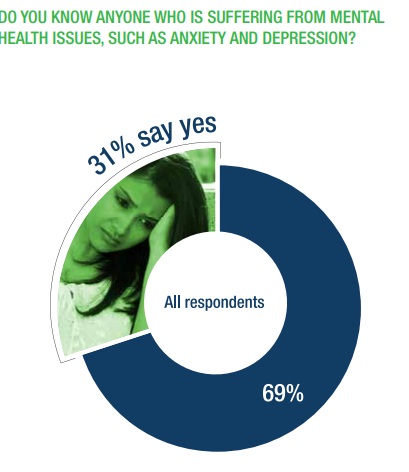
(Nearly a third of the respondents in the region know someone suffering from a mental illness)
Almost a third of the respondents (31pc) say they know of someone with mental health issues.
“Young Arabs are divided over whether there is a stigma attached to mental health issues in the Middle East, with 50pc saying they believed mental health issues were viewed as a negative thing by most people, while 49pc said such issues would be viewed as normal by most people,” says the survey.
In the GCC, 62pc see mental health issues as normal while 35pc say they could be viewed as negative.
For GCC youth the top three reasons behind mental health issues are personal relationships, academics and family issues.
The survey also provides an insight into how young Arabs view other nations in the region and beyond.
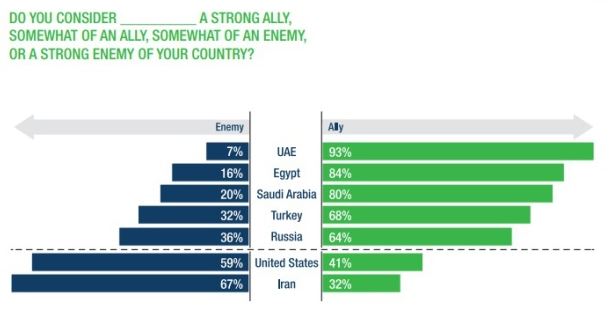
(Arab youth see Iran as their top enemy and UAE as the closest ally)
“The findings provide a solid summary of regional perspectives on other countries, with the UAE being most readily identified as an ally by respondents (93pc) and Iran as an enemy (67pc ),” said Arab Gulf States Institute in Washington senior resident scholar Hussein Ibish in the report.
“Unfortunately, for Washington, the US appears as the runner-up ‘enemy’ at 59pc, with a mere 41pc considering Washington an ally, continuing a striking downward trend in recent years.”
Meanwhile, regional conflicts are viewed by respondents as some of the biggest obstacles facing the Middle East today and want them to end.
A lack of Arab unity is viewed as a big challenge to the Middle East, chosen by one-in-three young Arabs (35pc), while the Palestinian-Israeli conflict and the Syrian civil war are each seen as obstacles by 28pc.
The survey did not include Syria due to the civil unrest in the country.
Seventy-six pc of respondents from the GCC said the war in Syria should end whether President Bashar Asaad is in power or not.
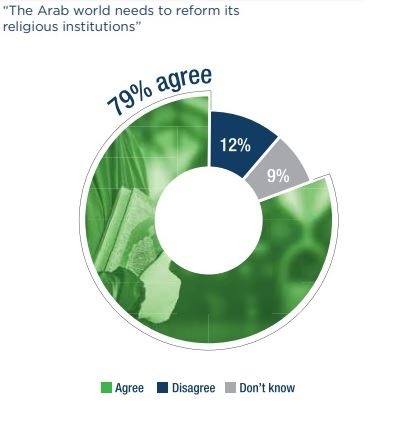
(A majority of the respondents said religious institutions in the Arab world needed to be reformed)
An overwhelming majority of young Arabs (79pc) believe religious institutions in the region need to be overhauled.
Economic concerns are on top of young Arabs’ mind, with more than half (56pc) saying the rising cost of living is the biggest challenge facing the Middle East today, followed by unemployment (45pc).
The majority of young Arabs say governments have a responsibility to provide a range of services and safeguards to all citizens, including: Safety and security (96pc), education (89pc), healthcare (88pc), subsidised energy (78pc), jobs (78pc) and housing (60pc).
The survey reveals that over the past five years, social media has become the dominant source for news among Arab youth, with 80pc polled saying that it was their preferred choice, followed by television (66pc), online news (61pc), newspapers (27pc) and radio(19pc).
“For 11 years, the survey has provided insights into the hopes, fears and aspirations of the region’s youth,” said ASDA’A BCW, president Sunil John.
“This year’s finding show that youth are looking at their governments to reshuffle their priorities, especially when it comes to the role played by religion and the seemingly endless conflicts – and they want to see change.”
sandy@gdn.com.bh
&uuid=(email))