

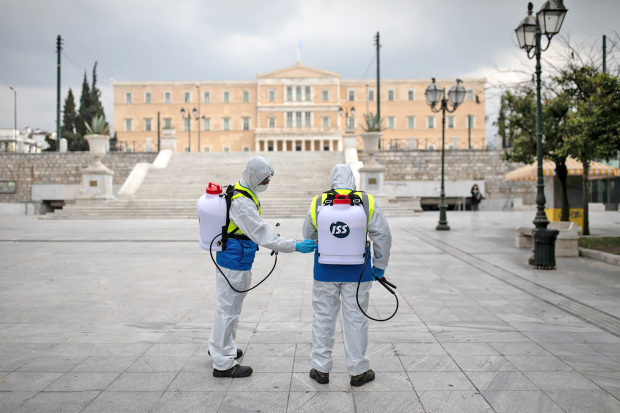
ATHENS: Ten years after sinking into its worst economic crisis in living memory, Greece once again faces the spectre of a grave recession in the midst of a global coronavirus lockdown.
Though the country has so far been spared the death toll of other European nations at fewer than 150 fatalities from Covid-19, it will not escape the resulting economic downturn, Prime Minister Kyriakos Mitsotakis warned this week.
“The consequences of this coronavirus attack will undoubtedly be dramatic,” he told parliament on Thursday.
“We know with certainty that (the recession) will be deep... we don’t know how long the health crisis will last, we don’t yet know if we’ll have tourism.”
Tourism is one of Greece’s most important sources of revenue, along with shipping.
The Greek state alone could lose 8-10 billion euros ($8.8-11bn) in income this year, the prime minister said.
Greece has already adopted measures worth 17.5bn euros, or 10 per cent of national output, to support businesses and employees, Mitsotakis said.
Including EU funds, the package will reach 24bn euros, he said.
But the opposition has questioned whether the money has actually reached the intended recipients.
“Where is this money? It’s good for announcements but actual businesses and (employees) have not received a single euro,” former leftist prime minister Alexis Tsipras said, predicting that layoffs will soon be “out of control”.
Greece this year had been counting on a growth spurt of 2.4pc. After exiting the final debt crisis bailout in 2018, its borrowing rates were at historic lows – in October Athens even sold treasury bills at a negative rate – and it has cash reserves of more than 36bn euros at hand.
But with most of its economy in virus quarantine since March and global lockdowns expected to wreak havoc on tourism, Greece is expected to sink into a 10pc recession this year, according to the International Monetary Fund.
Panagiotis Petrakis, professor of finance at the University of Athens, argued that the economic blow will be less severe.
“The most likely scenario is a 6pc contraction, provided there is no deterioration in the pandemic,” he said.
Petrakis also believes that the economic impact of this crisis will be less protracted. The IMF itself estimates a 5.5pc Greek recovery in 2021.
The Greek finance ministry says the downturn could be limited to 4.7pc through support measures, followed by a 5.1pc rebound. The jobless rate will approach 20pc, it said on Friday.
The government will begin easing lockdown restrictions this month, with most shops opening by May 11 and restaurants and year-round hotels following on June 1.
But few expect any foreign visitors before July.
Many Greek businesses fear the damage will be irreparable, especially with minimum two-metre social distancing requirements squeezing out customers.
“Last summer I had 10 tables outside and 10 inside. Now, I will just have three tables outside and I’m supposed to make do,” says Costas Gogos, owner of a tavern in the port of Rafina near Athens.
“Many will not even reopen, they won’t manage with so few tables,” added a neighbouring restaurant owner.
&uuid=(email))