

A new study to train police dogs to track down human traces from the crime scene in tough desert climate conditions has been launched by the Interior Ministry.
The first-of-its-kind study as part of the ministry’s modernisation strategy was presented by policewoman Nawal Ahmed from the K9 Police Dogs Division of the Special Security Force.
It will be held in co-operation with the Bahrain University that will provide scientific assistance by forming a team of specialists.
The research will also explore ways to use sniffer dogs – the K9 Unit – in the early detection of diseases like cancer.
“Several studies in European countries highlighted the impact of cold temperature on human traces, but there are no research on hot weather conditions,” said Ms Ahmed yesterday.
“This will help in upgrading our training (for K9) to the highest advanced levels which will in turn contribute to enhancing our security, and identifying new methods for accurately detecting crimes.”
The policewoman highlighted that human traces are key evidence in criminal cases at the crime scene to identify and track individuals.
A sniffer dog is trained to use its senses – which dogs are famous for – to detect substances such as explosives, currency, illicit electronic items as well in tracking crimes.
Studies have also revealed that canines are able to detect specific odours associated with numerous medical conditions, such as cancer.
Bahrain University’s College of Science’s Life Sciences department head Dr Salwa Mutlaq Al Thawadi who welcomed the study in Bahrain noted that the effort will contribute to identifying new methods for accurate detection.
“The study will assess various cases and crimes and come up with observations and results that will help in further raising the efficiency of the performance of police dogs,” said Dr Al Thawadi.
“This study can also be used to detect various diseases.
She said that the study would contribute to solving various crimes through the collection of evidence by enhancing the performance of K9 dogs within high temperate, humidity, and other environmental factors.
Dogs have so many more genes that code for olfactory ability than humans – 220 million scent receptors against humans with only five million.
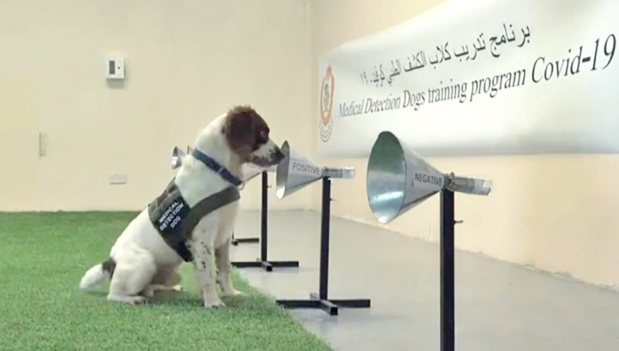
The GDN reported that the Interior Ministry has plans to use their sniffer dogs to detect Covid-19 at Bahrain’s airport under a pilot project.
Professionally-trained police dogs will sniff sweat swabs of travellers to check if they are infected with the virus that causes Covid-19, as part of the plan.
If the result is positive, the passenger could be asked to take a RT-PCR (reverse transcription polymerase chain reaction) coronavirus test, to check the dog’s accuracy.
The UAE reported in September that police in Dubai have built up a special unit of 38 sniffer dogs that can detect Covid-19 from human sweat samples with 92pc accuracy.
Its cohort including German Shepherds, Labradors, Cocker Spaniels and Border Collies are trained to recognise the scent of Covid-19 using samples of sweat from people with confirmed infections, collected by holding a swab in an armpit for a few minutes.
&uuid=(email))