

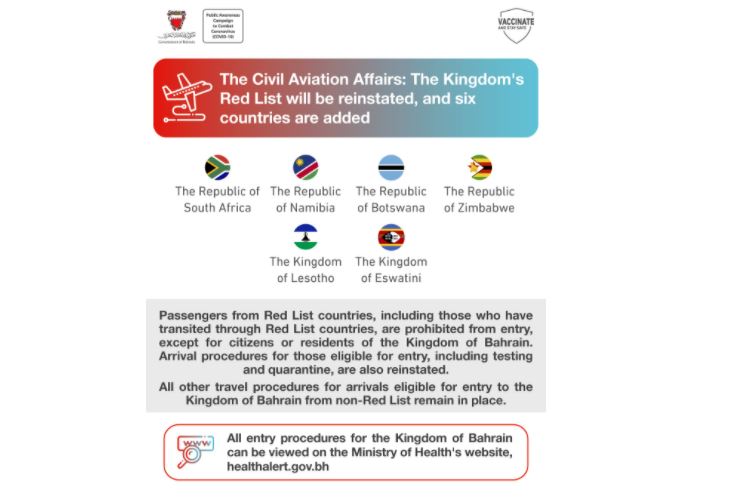
BAHRAIN has reinstated the travel red list following the emergence of a new Covid-19 variant that has sparked global concern.
The six countries on the list are South Africa, Namibia, Lesotho, Botswana, Eswatini and Zimbabwe.
The Civil Aviation Affairs said the decision has been taken following the recommendations of the National Taskforce for Combating Covid-19.
All passengers from the six countries, including those who transit through them, have been banned from entering Bahrain. However, citizens and residents of Bahrain have been exempted.
Those eligible for entry will, however, have to undergo quarantine and Covid-19 testing according to government protocols.
Travel procedures for arrivals from non-Red List countries remain in place.
Entry procedures for Bahrain can be viewed on the Health Ministry website, healthalert.gov.bh.
The UAE and Saudi Arabia also suspended entry for travellers from South Africa, Namibia, Lesotho, Eswatini, Zimbabwe, Botswana and Mozambique starting from November 29.
The discovery of the new variant triggered global alarm yesterday as countries rushed to suspend travel from southern Africa and stock markets on both sides of the Atlantic suffered their biggest falls in more than a year.
The US will restrict travel from South Africa – where the new mutation was discovered – and neighbouring countries effective Monday, a senior Biden administration official said.
Going further, Canada said it was closing its borders to those countries, following bans on flights announced by Britain, the European Union and others.
The World Health Organisation (WHO) said it was designating the variant, named omicron, as being “of concern”, a label only given to four variants to date.
But it could take weeks for scientists to fully understand the variant’s mutations. Health authorities are seeking to determine if omicron is more transmissible or infectious than other variants and if vaccines are effective against it.
South Africa’s Health Minister Joe Phaahla called the travel restrictions “unjustified”, though he also said preliminary studies suggested the new variant may be more transmissible.
“This new variant of the Covid-19 virus is very worrying. It is the most heavily mutated version of the virus we have seen to date,” said Professor Lawrence Young, a virologist at Britain’s Warwick university.
“Some of the mutations that are similar to changes we’ve seen in other variants of concern are associated with enhanced transmissibility and with partial resistance to immunity induced by vaccination or natural infection.”
Several other countries including India, Japan, Israel, Turkey and Switzerland also toughened travel curbs.
The variant has a spike protein that is dramatically different to the one in the original coronavirus that vaccines are based on, the UK Health Security Agency said, raising fears about how current vaccines will fare.
“As scientists have described, (this is) the most significant variant they’ve encountered to date,” British Transport Secretary Grant Shapps told Sky News.
The coronavirus has swept the world in the two years since it was first identified in central China, infecting almost 260 million people and killing 5.4 million.
One epidemiologist in Hong Kong said it may be too late to tighten travel curbs against the latest variant.
“Most likely this virus is already in other places. And so if we shut the door now, it’s going to be probably too late,” said Ben Cowling of the University of Hong Kong.
Belgium identified Europe’s first case, adding to those in Botswana, Israel and Hong Kong.
&uuid=(email))