

IRAN’S malign influence and activities in the region have now reached the skies with the proliferation of Unmanned Aerial Vehicles (UAV), warned the Bahrain-based Fifth Fleet commander.
Vice Admiral Brad Cooper said that Iran continues with its hostile regional activities which require strong partnership with the Gulf and neighbouring countries to act as a strong deterrence.
“Today, Iran is the most serious threat that we see in the region,” he said.
“The threat manifests itself in many forms including the nuclear component and on the conventional side is the growth in ballistic missile defence force, capability in cruise missiles, and further growth and capabilities in Iranian UAVs.”
Vice Adm Cooper was speaking during the Maritime Security Dialogue hosted last week by the Washington DC-based think tank, Centre for Strategic and International Studies.
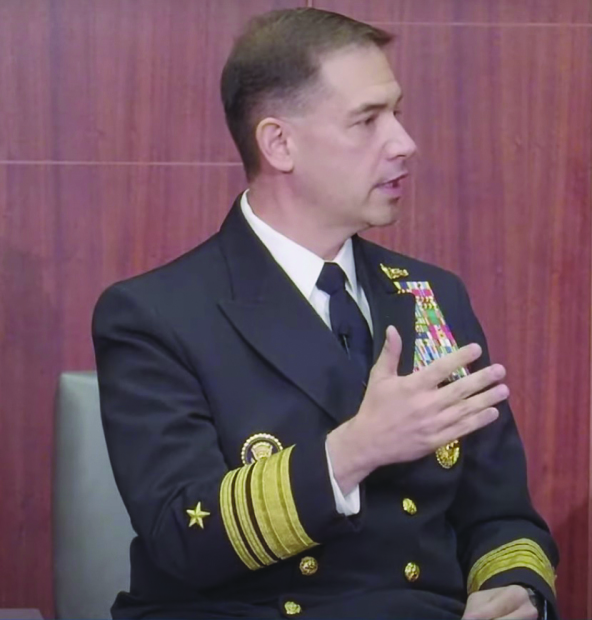
Vice Adm Cooper
He stated while majority of their daily interactions with Iranian counterparts were “safe and professional”, they did not shy away from sharing their views with Tehran if their actions were the opposite.
“What is different now is the dramatic uptick in the UAV activity in the region, both in terms of their capability and density,” said Vice Adm Cooper.
He cited the example of the drone attack on MT Mercer Street oil tanker off the Omani coast which killed two people in July last year.
To step up its maritime vigilance, the Fifth Fleet last September set up the headquarters of Task Force 59 aimed at combating threats from unmanned systems and artificial intelligence (AI).
The following month, the BDF worked with the Fifth Fleet and operated an unmanned surface vessels (USV), Mantas T-12, during an exercise.
“Having more sensors above a body of water increased the maritime domain awareness and our deterrent posture, this has brought us a lot of information that is being reviewed using AI.” Drones can spot unusual movement or pattern of life which is captured on camera and transmitted via satellite to decision-makers to analyse, and this has changed the conventional way of deploying large ships.
“The drones that we have operating (as part of TF59) at Aqaba (Jordan) have been at sea for 33 straight days.
“They are really redefining what persistence means in the maritime environment.”
A week after Vice Adm Cooper warning of rogue drones, on Monday Iranian-backed Houthi rebels in Yemen claimed UAV attacks on an oil facility in Abu Dhabi in which two Indians and a Pakistani were killed, with six others injured.
In addition, the attacks sparked a separate fire at Abu Dhabi’s international airport.
Meanwhile, Vice Adm Cooper highlighted increased Iranian proxy activities in Lebanon, Iraq, Syria and Yemen.
The smuggling of drugs and weapons allegedly linked to Iran posed another challenge, he added.
“Last year, we interdicted more than $200 million worth of drugs with a street value of more than $1 billion which exceeded the previous four years’ haul.”
He was referring to the ongoing efforts by the Bahrain-based 34-nation Combined Maritime Force (CMF) that has three task forces with Combined Task Force (CTF) 150 taking the lead in clamping down on drug smuggling drugs at sea, the proceeds of which officials believe fund terrorists.
US Navy assets deployed under the Fifth Fleet last month seized approximately 1,400 AK-47 assault rifles and 226,600 rounds of ammunition from a stateless fishing vessel sailing in the North Arabian Sea with links to Iran.
Nearly 8,700 illicit weapons were seized last year, the Fifth Fleet said.
Bahrain has long accused Iran of funding, training and equipping extremists to carry out a campaign of violence against security personnel in the kingdom, finally cutting diplomatic ties with Tehran in 2016.
sandy@gdn.com.bh
&uuid=(email))