

More than two million pieces of botticino marbles, mosaic and coloured glasses were used to restore the minaret of a historic mosque to its original glory, it has emerged.
The 35-metre tall iconic structure at the Al Fadhel Mosque, built more than two centuries ago, was unveiled last night by the Bahrain Authority for Culture and Antiquities (Baca).
The beautiful minaret was originally designed in 1938 and the document that made the restoration possible was a photograph by Maynard Owen Williams in 1946 for the National Geographic Magazine.
Baca director general of culture and arts Shaikha Hala bint Mohammed Al Khalifa and guests attended the event held at the mosque in Manama to showcase the minaret’s colourful wall of mosaics of more than 300sqm inspired by its original design.
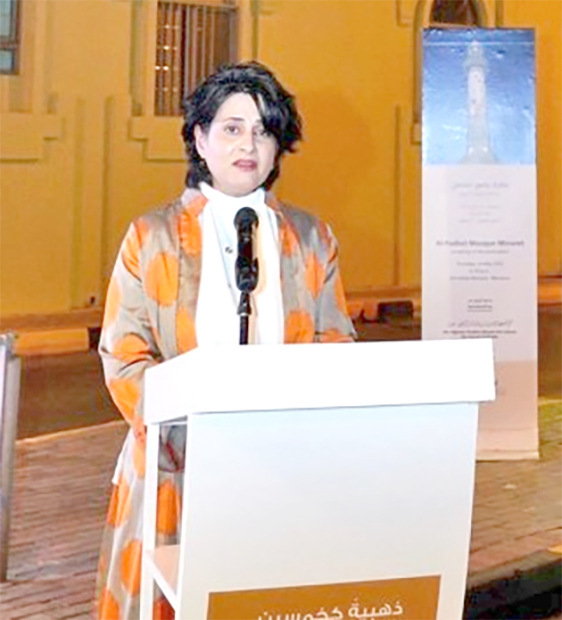
Shaikha Hala
“We are here at the heart of the capital of my country to unveil the result of four years of work,” Shaikha Hala said during the unveiling ceremony.
“The project welcomed a great team from Italy who have gathered two million pieces to maintain the minaret’s beauty and with it the memory and identity of Manama.”
Thirty-five experts from the Centro di Conservazione Archeologica (CCA), Rome, worked on the project for 2,200 days. They used 2,034,821 mosiac, coloured glasses, and botticino marble pieces to recreate the intricate design of the minaret.
It is believed that the mosque was built with palm fronds in 1768 by a member of the Al Fadhel family as a site for the five daily prayers. Years later, it was rebuilt using stones and earthen plaster and later transformed into a mosque for Friday prayers.
The minaret was built in 1938, close to the sea at the time, and greeted travellers coming in through the waters for trade. It was made entirely of coral stone and covered with majolica tiles, believed to have been imported from Italy.
However, the minaret went through several renovations and the original design was lost in the process.
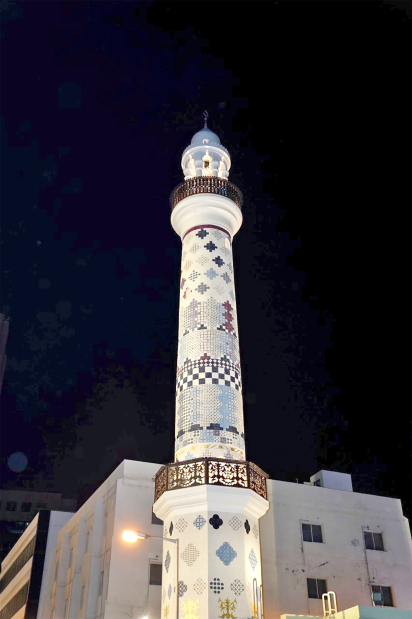
The minaret after its restoration. (Picture: Hussain Almosawi)
“This was one of the most challenging projects for my team,” CCA project manager Roberto Nardi said at the event last night. “We were tasked with restoring the original minaret and its historical identity.”
Mr Nardi explained how his team met residents to gather their recollections of the minaret and the stories told to them by their parents and grandparents.
“We wanted to capture not just the image, but the authentic feel and identity of the minaret,” he added.
However, it was Mr Williams’ photographs that proved to be a gamechanger.
“The images that we initially had portrayed the design, but they were all in black and white,” said Mr Nardi.
“Mr Williams’ images for the National Geographic Magazine revealed to us both the colours of the minaret and the base design of the tower.
“The team, albeit a bit delayed due to the pandemic, were able to retrieve the beauty of the original minaret with help from Baca’s experts.
“Bahrain has been very welcoming to us and our work. Baca president Shaikha Mai bint Mohammed Al Khalifa and her team have aided us at every step and we are thankful to them for the support,” he added.
&uuid=(email))