

THE government is pushing ahead with plans to ensure more jobs for citizens, with firms failing to achieve the Bahrainisation quota paying BD500 for every expatriate recruited above the stipulated limit, a top minister has said.
Labour Minister Jameel Humaidan asserted that companies that breach the rule were also ineligible for government tenders.
“The Bahrainisation percentage for most sectors has been currently set at 50 per cent,” the minister, who is also Labour Market Regulatory Authority (LMRA) board chairman, said in response to a question by MPs.
“The figures are, however, assessed regularly depending on labour market employment variables,” he added.
Mr Humaidan said all business sectors and activities, without exceptions, have to follow the Bahrainisation quota which is determined by the nature of the job and its appeal to citizens.
“Companies that fail to reach the targeted percentage are ineligible to enter government tenders,” he added.
“However, I have to stress that most firms in the country have voluntarily achieved a Bahrainisation rate of between 80pc and 90pc.
“It is not just the percentages that matter to us, we also seek proper pay, work hours and working environment for citizens that are hired. We are also ensuring qualified Bahrainis progress at every stage and get promoted at work.”
The minister revealed that the 2021-2023 National Labour Market Plan was 74pc complete.
“The plan ends by July this year, and the new 2023-2027 strategy is being prepared by concerned departments,” said Mr Humaidan.
“Any employer found recruiting expatriates illegally, in violation of labour laws, is fined between BD1,000 and BD2,000 per worker.
“We conducted 27,019 visits last year and 292 inspections, in which 1,043 employers and 1,534 workers were found to have breached the norms.
“Any company that fails to reach Bahrainisation percentages is also charged BD500 electronically for each expatriate worker they hire beyond the set limit. The BD500 fee will be charged every time the visa is renewed until the firm achieves the Bahrainisation quota.”
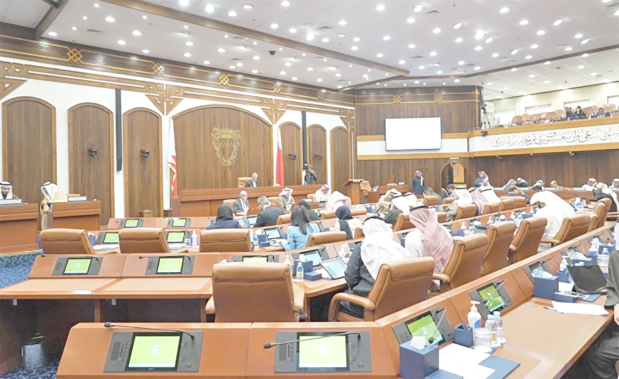
The minister was responding in writing to four questions by MPs on jobs for citizens.
He added that women constituted 76pc of those unemployed in the country.
“Companies seeking to fill vacancies cannot employ expats for 21 days as they have to make job announcements in local newspapers. This initiative has resulted in employment for 10,868 Bahrainis,” said Mr Humaidan.
“Yes, jobs for women remain an issue and we are seeking to address it by introducing new incentives and schemes for employers. Among those employed last year, 41pc were women.”
He added that 1,686 Bahrainis were also employed in medical professions.
The minister stressed that jobs for citizens were the government’s top priority and loopholes in laws that allowed companies to recruit expats were being closed.
“There are other challenges like balancing supply and demand in the labour market, but we managed to get a total of 29,995 employed last year,” he said. “Out of them, 7,788 were newcomers and 22,207 found better jobs, with 17,714 being females and 12,281 males. The average pay was BD502 for those hired last year.”
Mr Humaidan said 473 jobseekers were listed with the ministry until last year.
Meanwhile, Parliament and Shura Council Affairs Minister Ghanim Al Buainain, who is politically responsible for the Civil Service Commission, said in writing that 6,979 expatriates hold jobs in ministries, and government authorities.
“Out of them, 1,206 were brought in during the pandemic to help with work in the Health Ministry,” said Mr Al Buainain.
“Around 88pc of the jobs occupied by expats are in the health and higher education sectors.”
Education Minister Dr Mohammed Mubarak Juma will also appear in Parliament on Tuesday to respond to a question on expats employed at the ministry.
Parliament is set to vote on the government’s closing financial statements for 2021.
The government announced plans to set the 2023-2024 national budget calculation on $60 to reach fiscal balancing in 2024.
MPs will also vote on a royal decree issued by His Majesty King Hamad during the National Assembly recess last year to amend the 2022 Unified GCC Customs Law.
mohammed@gdnmedia.bh
&uuid=(email))