

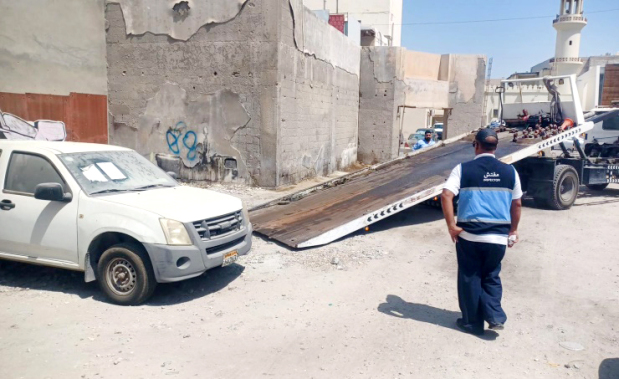
Councillors have called on the authorities to implement a clearly defined system to remove scrap and abandoned vehicles from public roads and residential areas.
They claimed that many vehicles have been occupying public space for years, depriving citizens of the much-needed parking slots.
They also alleged that the current procedure in place was rather haphazard, despite the government asserting that a mechanism is in place.
Members of the Northern Municipal Council were yesterday debating the need for specific rules and criteria to clear the vehicles which have occupied public roads and residential areas in violation of the 2019 Cleanliness Law and the 1996 Public Road Occupancy Law.

Councillors and municipal officials at yesterday’s meeting
In a written response, Municipalities Affairs and Agriculture Minister Wael Al Mubarak told councillors that the concerned municipalities had to alert owners with a phone message before issuing fines and removing the vehicle.
“This is an absurd situation; there are regulations, but how is it possible that no mechanisms are created for proper implementation,” questioned council’s technical committee chairman Abdullah Al Qubaisi.

Mr Al Qubaisi ... clear answers on abandoned vehicles sought
“We just want to know the process and adequate action. Inspectors impose the same penalty on cars that are abandoned, cars that are junk and dusty, and vehicles that are just old – that doesn’t seem fair.
“People are fined BD100 if their dusty cars are removed from the roads in front of their house, which is unfair again.”
He reiterated that a clearly defined mechanism could also reduce the number of disputes between citizens and the municipality.
Mr Al Qubaisi alleged that inspectors ‘just randomly’ guessed if cars were abandoned and slapped fines and issued warnings without investigating the status of the vehicle.
If owners don’t claim their vehicles within three months of removal, its registration is cancelled – even if the car is brand new – in collaboration with the General Directorate of Traffic. The four-wheeler is then sold as scrap in an auction.
Mr Al Qubaisi asked his colleagues to vote on a clear decision to have abandoned cars removed – which they did.
“For example, the Ramli District is a new residential area, but half of its available car parks are occupied by abandoned or wrecked cars,” he said.

Wrecked cars being towed away
“Also, in Salmabad, new businesses and homes have been built, but the area is still treated as a dumping ground for unwanted vehicles.
“The same problem exists in Hamad Town, Budaiya, Hamala even though in lower scales, and it’s unacceptable.”
Meanwhile, the council’s legislative, administrative and financial committee chairman Dr Salman Abdulla said abandoned vehicles outside homes were a nuisance and legal concern.
“Abandoned vehicles parked outside homes are an eyesore and a source of frustration for residents,” he said.

Dr Abdulla ... abandoned cars are an eyesore
“These neglected cars, trucks, and even recreational vehicles take up valuable parking spaces and violate local laws. “Almost all towns and cities limit how long a vehicle can remain parked on a street, except here in Bahrain, as many cars and vehicles are left in a bad shape for so long.”
Dr Abdulla added that abandoned vehicles outside homes not only marred the neighbourhood’s aesthetics but also disrupted parking availability.
“By understanding local laws, reporting violations, and engaging with neighbours and authorities, residents can collectively address this issue and maintain a cleaner, more organised living environment,” he said.
“Proactive community involvement and adherence to local regulations are essential in ensuring that abandoned vehicles do not become a persistent problem.”
The GDN earlier reported that a decision on who is responsible for towing unused, abandoned, unregistered or scrap vehicles was being sought by the Shura Council.
mohammed@gdnmedia.bh
&uuid=(email))