

More than 850 employees from 17 government and private institutions have been trained so far as frontline workers to assist potential victims of trafficking.
This was highlighted during a workshop hosted by the Labour Market Regulatory Authority’s (LMRA) Regional Centre of Excellence for Capacity Building for Combating Trafficking in Persons, at the government agency’s headquarters, in Sanabis.
The awareness session, titled ‘Identifying and Responding to Human Trafficking Cases’, brought together media professionals to strengthen their role in exposing abuses and protecting victims.
Speaking at the event, an Expat Protection Centre (EPC) representative praised Bahrain’s strides in tackling trafficking, stressing that the kingdom has become a model in the region for its comprehensive legal, institutional and awareness-raising measures.
“Bahrain’s consistent Tier 1 ranking reflects its unwavering commitment to fighting trafficking,” said the representative.
“Through extensive training, the establishment of specialised institutions, and proactive reforms, the country has created an advanced framework that protects workers and ensures accountability.
“A total of 887 employees from 17 government and private bodies have been trained through the centre’s programmes, in addition to the accreditation of 88 national trainers and the rollout of standardised training curricula.”
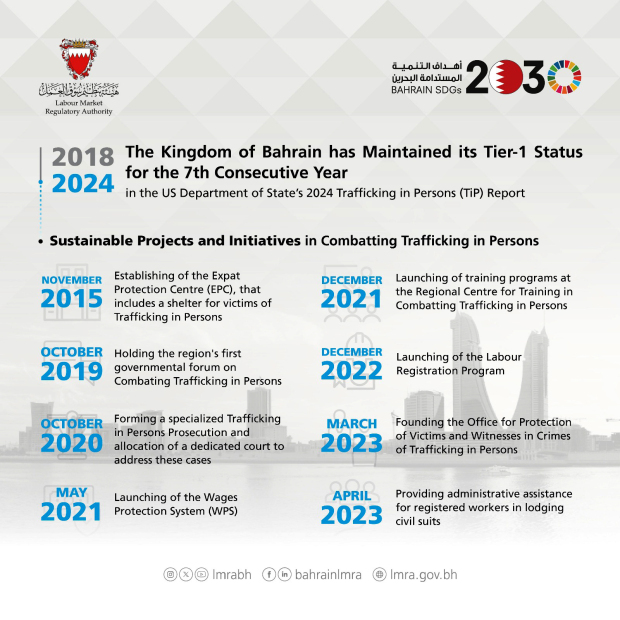
Bahrain’s anti-human trafficking record over the years
Meanwhile, the representative also outlined milestones in Bahrain’s anti-trafficking journey, including, issuing the Anti-Trafficking Law in 2008 and creating the National Committee; establishing the Victim Protection Centre and hotline 995 in 2015; launching the National Referral Mechanism in 2017; opening the Regional Training Centre and introducing the Wage Protection System in 2019; and creating the region’s first specialised trafficking prosecution unit in 2020.
“These steps are not symbolic, they represent practical protections for workers and victims of trafficking, ensuring Bahrain remains aligned with international best practices,” added the EPC representative.
Interior Ministry officer Captain Mariam Al Shurooqi stressed that traffickers exploit vulnerable groups, often through deception, coercion, or abuse of authority.
“Migrant workers in the Gulf face risks linked to debt bondage, forced labour, and coercive practices,” Captain Al Shurooqi pointed out.
“Recognising these indicators is vital to breaking cycles of exploitation.”
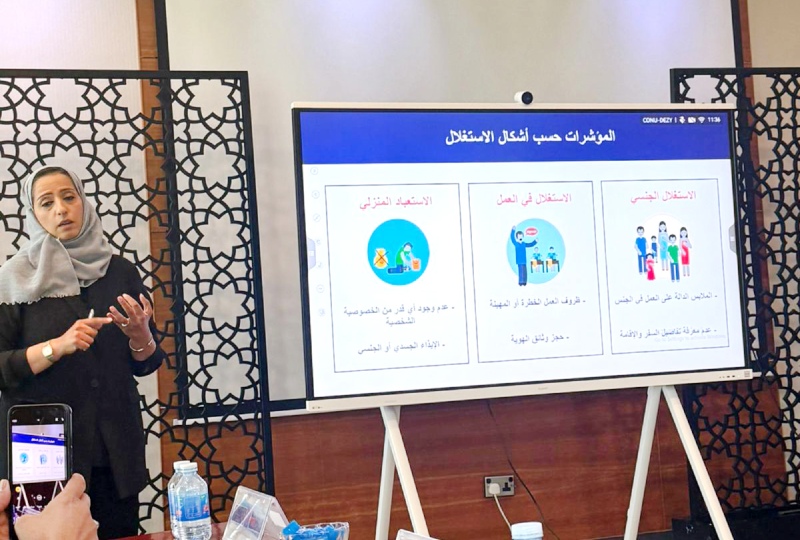
Dr Al Rashid
Dr Maha Al Rashid from Bahrain University emphasised the importance of the media’s role in sustaining Bahrain’s success.
“Journalists and media professionals are essential partners in maintaining Tier 1 status,” she said.
“Their ability to reveal victims’ stories and raise awareness ensures transparency, accountability and community protection.
“With its Tier 1 ranking reaffirmed, Bahrain stands out as the only country in the region consistently recognised for meeting international standards in victim protection, prevention and prosecution.”
Cases of human trafficking, including underage exploitation, were highlighted during the workshop.
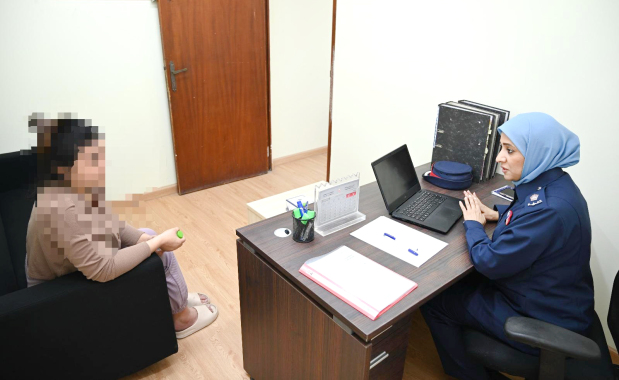
A special office set up earlier this year by the Interior Ministry to support victims of human trafficking
Bahrain maintained its ranking in the 2024 annual Trafficking in Persons (TIP) report released by the US State Department for the seventh consecutive year.
The TIP 2024 report placed Bahrain in the Tier 1 status – the only GCC country recognised as being fully compliant with the Trafficking Victims Protection Act’s minimum standards for elimination of human trafficking.
The 24th edition of the annual report featured narratives on 188 countries and territories, and covered the period from April 1, 2023 to March 31, 2024.
During the reporting period, the Interior Ministry investigated 46 cases (involving 66 alleged traffickers) – 17 for sex trafficking, 27 for labour trafficking and two cases involving both.
The LMRA referred 32 potential trafficking cases to the Public Prosecution’s Trafficking in Persons Unit – 31 for labour trafficking and one for sex trafficking.
The report categorises countries into four sections as mandated by the TVPA, which is the American law against human trafficking.
Tier 1 nations fully meet TVPA standards, while Tier 2 and Tier 2 watchlist nations do not fully comply with the minimum standards for the elimination of trafficking, though making significant efforts to do so.
Countries not complying with the minimum standards are placed in Tier 3 and subjected to certain US sanctions.
Latest statistics show that authorities dealt with 22 human trafficking cases from January 2024 until January this year, resulting in the arrest of 50 individuals, and further assistance was provided to 41 victims.
Members of the public can report anti-trafficking cases via hotline 555, operations room 999, or email 555@interior.gov.bh, with full confidentiality guaranteed.
The hotline is available in Arabic, English, Hindi and Urdu.
mohammed@gdnmedia.bh
&uuid=(email))