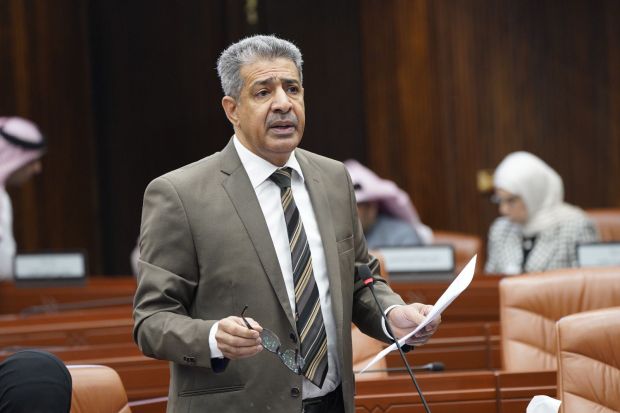
MPs have called on the government to develop a comprehensive national strategy for artificial intelligence (AI), with an aim to integrate the technology into the kingdom’s fastest-growing economic sectors.
The proposal, submitted by MP Dr Muneer Suroor, calls for the creation of a unified framework that boosts national capabilities, attracts investment, and prepares Bahrain’s workforce for the future digital economy.
It envisions the establishment of a National Artificial Intelligence Centre, promotion of AI-focused investments and training programmes to develop Bahraini expertise in AI applications across key sectors such as finance, industry, health, and education.
It also seeks to update Bahrain’s regulatory frameworks to ensure the safe, ethical, and effective use of emerging technologies. Dr Suroor said the initiative reflects Bahrain’s determination to embrace innovation and technology as drivers of economic growth and diversification.
“This proposal is about placing Bahrain at the forefront of the digital economy,” Dr Suroor explained.
“A well-designed AI strategy will not only enhance government efficiency and service quality but also create new, high-value job opportunities for Bahrainis, attract local and foreign investment, and ensure sustainable economic growth.”
According to the proposal, the initiative aims to create quality employment opportunities for citizens, improve the speed and efficiency of public services, support small and medium enterprises and diversify national income sources.
It has received strong backing from several key government bodies, including the Economic Development Board (EDB).
EDB noted that Bahrain has already made major strides towards a digital and knowledge-based economy. It highlighted the inclusion of AI in the Economic Recovery Plan launched in 2021, which prioritised digital economy, financial innovation, and industrial modernisation.
The EDB also cited a number of national initiatives, including Tamkeen’s programme to train 50,000 Bahrainis in AI skills, the National AI Policy and Ethical AI Guidelines issued by the Information and eGovernment Authority and integration of AI tools in public sector services to boost efficiency and transparency.
The Finance and National Economy also endorsed the proposal, calling it “a constructive and forward-looking initiative aligned with the government’s transformation agenda.”
The ministry noted that Bahrain is already leveraging AI for economic modelling, data-driven policy analysis, and growth forecasting. It also cited projects in education such as the Bahrain Polytechnic’s AI Academy, and in youth innovation, through the Khalid bin Hamad AI and Innovation Competition and Hackfest Bahrain.
In the real estate sector, the Survey and Land Registration Bureau has introduced an AI-based system to monitor urban changes and detect building violations, helping improve urban planning and environmental management.
The Nasser Centre for Science and Technology described the proposal as ‘a vital strategic step’ towards positioning Bahrain among the regional leaders in innovation and competitiveness.
The centre recommended prioritising AI deployment in industrial sectors like oil, gas, aluminium and ship repair, as well as in healthcare, where AI can predict and prevent chronic diseases.
The financial and economic affairs committee, chaired by MP Ahmed Al Salloom, has reviewed the proposal and expressed unanimous support.
“The adoption of a national AI strategy will strengthen Bahrain’s position as a hub for smart industries and sustainable growth,” Mr Al Salloom said.
The committee’s report concluded that implementing a unified AI strategy would help diversify economy and prepare the nation for the opportunities and challenges of the Fourth Industrial Revolution.