The Khalifa Bin Salman Port (KBSP) has become the first port in the region to operate entirely on self-generated renewable energy, following the launch of an 11.1-megawatt (MW) solar project, the operator announced yesterday.
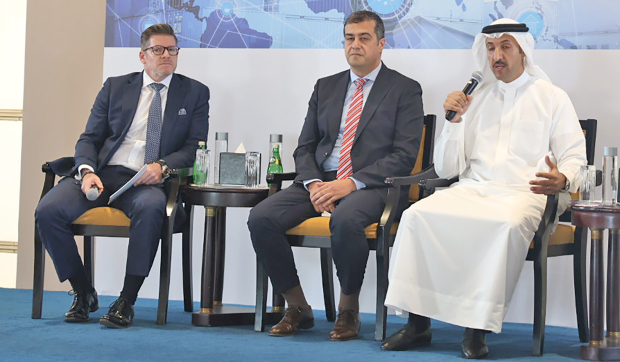
Speaking at an American Chamber of Commerce (AmCham) panel discussion at The Ritz-Carlton, Bahrain APM Terminals Bahrain chief executive and managing director Matthew Luckhurst revealed the milestone, which has already delivered a 62 per cent reduction in CO2 emissions and generated a significant power surplus for the national grid.
“We are the first and only port in the region that is completely self-sufficient on renewable energy; we don’t take any energy out of the grid at all,” Mr Luckhurst confirmed. “In fact, year to date, we have a surplus power generation of 3 GWh – that is equivalent to a hundred homes here in Bahrain.”
APM Terminals, part of the AP Møller-Maersk Group, has set a target to achieve a 70pc reduction in CO2 emissions by 2030 and reach Net Zero by 2040.
The achievement is the result of an $11 million self-funded investment for the solar installation, which covers the port’s major warehouses.
Mr Luckhurst noted the robust financial model of the project, stating that the returns are “pretty reasonable,” with a projected seven-year payback period under current agreements with the Electricity and Water Authority (EWA).
The transition is now moving into the heavy equipment phase, with the port systematically changing its horizontal transport and container handling machinery to full electric vehicles (EVs), moving away from hydrocarbon-powered equipment.
Despite the port being recognised as the “most efficient port” in one international index for its size in 2024, the CEO highlighted key strategic challenges vital to Bahrain achieving its “leading logistics hub” goal.
The primary concern is cross-border trade friction, which must be eliminated to allow Bahrain to participate in the growth of neighbouring countries, particularly Saudi Arabia.
“We have to have everybody talking to each other to make sure there is complete alignment across the border,” Mr Luckhurst urged. He explained this required accelerating the development of port community systems to ensure government agencies are aligned in the process of moving cargo from KBSP.
He confirmed APM Terminals is participating significantly in the newly developed National Maritime Strategy to ensure agencies are aligned and trade friction is removed.
Mr Luckhurst concluded by detailing how artificial intelligence (AI) is being used to drive productivity. The port employs digital twins to simulate vessel movements and optimise resource allocation.
“It’s purely about driving productivity and efficiencies,” he explained. “What it means to the everyday user is that the price of a landed commodity that you’re buying off the shelf should, in principle, get cheaper as we drive better productivity.”
avinash@gdnmedia.bh