

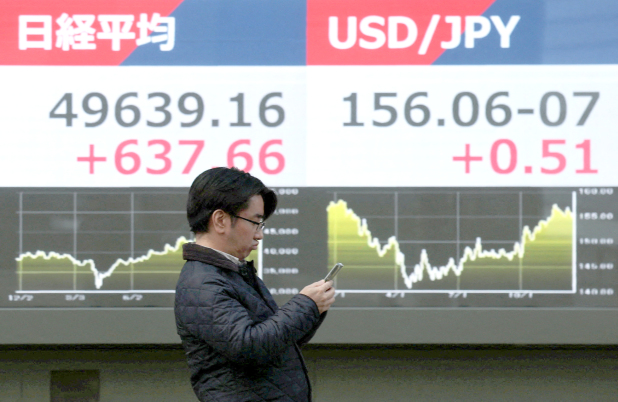
MSCI’s global equities gauge was advancing yesterday with technology leading Wall Street higher while the yen weakened after the Bank of Japan raised interest rates to a three-decade high and left the door open to further tightening.
Oil prices rose as traders weighed the potential impact of supply disruption from Venezuela, as US President Donald Trump told NBC News in an interview published yesterday he was leaving the possibility of war with the country on the table. The BOJ’s widely expected rate hike led investors to sell the yen on the fact and drove some profit-taking, prompting traders to consider the chances of official intervention to support the currency. Japan’s 10-year government bond yield hit a 26-year peak and the Nikkei closed up 1pc.
On the US data front, existing home sales rose marginally in November as economic uncertainty and still-elevated mortgage rates curbed demand. University of Michigan’s survey of consumer sentiment came in lower than consensus estimates but above the November number.
“The economy may be moving out of what appears to have been a mild soft patch in economic growth,” said Gary Schlossberg, global strategist at Wells Fargo Investment Institute, referring to yesterday’s data and Thursday’s consumer price inflation of 2.7 per cent even as he cautioned that CPI may have been distorted by the 43-day government shutdown.
“We could still be feeding off the CPI news yesterday. It’s an important event at face value. We’re a little sceptical just how much of an improvement in inflation we saw,” said Schlossberg but he added that “it looks like inflation may have peaked, at least for now. That has to be good news for the Fed and by extension markets.”
MSCI’s gauge of stocks across the globe rose 7.08 points, or 0.71pc, to 1,008.26 while the pan-European STOXX 600 index rose 0.44pc.
On Wall Street at 11.42am, the Dow Jones Industrial Average rose 280.23 points, or 0.58pc, to 48,232.08, the S&P 500 rose 56.22 points, or 0.83pc, to
6,830.98 and the Nasdaq Composite rose 256.36 points, or 1.11pc, to 23,262.72.
In currencies, the yen weakened sharply against the dollar and other major currencies as traders drove it towards levels that could trigger official buying after the Bank of Japan raised rates to a 30-year high but did not offer clarity on future hikes.
Against the Japanese yen, the dollar strengthened 1.22pc to 157.44.
The dollar index, which measures the greenback against a basket of currencies including the yen and the euro, rose 0.2pc to 98.64, while the euro was down 0.03pc at $1.1718.
In fixed income markets, US Treasury yields rose in line with global bond yields yesterday after the Bank of Japan raised interest rates, while investors continued to evaluate delayed economic releases and the direction of Federal Reserve policy.
The yield on benchmark US 10-year notes rose 2.3 basis points to 4.139pc, from 4.116pc late on Thursday while the 30-year bond yield rose 1.8 basis points to 4.8181pc.
The 2-year note yield, which typically moves in step with interest rate expectations for the Federal Reserve, rose 2.3 basis points to 3.483pc, from 3.46pc late on Thursday.
In energy markets, oil prices rose as the market waited for news about a possible Russia-Ukraine peace deal and monitored US moves regarding Venezuela while also digesting the latest central bank interest rate decisions around the world. US crude rose 0.82pc to $56.61 a barrel and Brent rose to $60.25 per barrel, up 0.72pc on the day.
Gold prices rose slightly as a stronger US dollar and rising Treasury yields dented demand for the non-yielding metal, though bullion was still set for a weekly gain.
Spot gold rose 0.26pc to $4,342.99 an ounce. US gold futures rose 0.34pc to $4,354.40 an ounce.
Meanwhile, stock markets in the UAE were mixed yesterday, with Dubai rebounding as steady oil prices and US data kept investors focused on the Federal Reserve’s rate path.
Dubai’s benchmark index gained 0.6 per cent, recovering from the previous session’s losses and marking a fourth straight weekly rise.
Salik Company climbed 3.2pc and Dubai Electricity and Water Authority added 2.9pc after the utility said it awarded a 216 million dirhams contract to improve the efficiency and reliability of Dubai’s water transmission network. “The market’s potential for further growth remains intact, given the local economy’s strong fundamentals,” said George Pavel, general manager at Naga.com Middle East, adding that liquidity could soften into year-end and the market remains below its peak.
In the United States, inflation rose less than expected in the year to November, though analysts cautioned the figures were likely distorted lower by the government shutdown. Weekly jobless claims fell, reversing the prior week’s jump and pointing to stable labour market conditions. Traders see a 58pc chance of a dovish Fed move in March. US policy is closely watched in the Gulf, where most currencies are pegged to the dollar.
In Abu Dhabi, the index fell 0.3pc, dragged by a 1pc drop in Aldar Properties and a 1.2pc loss in Abu Dhabi Commercial Bank. ADNOC Drilling rose 2.5pc and ADNOC Gas gained 1.4pc. Separately, ADNOC said it secured a $2bn green financing facility backed by Korea Trade Insurance Corporation.
&uuid=(email))