

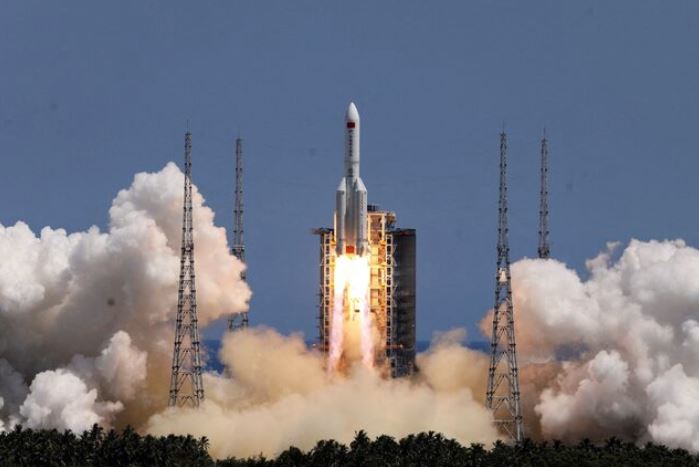
The first stage of China's reusable Long March 12A "was not successfully recovered" during the rocket's inaugural flight on Tuesday, according to its developer, as Beijing looks to close the gap with U.S. aerospace company SpaceX.
The rocket took off at 10 a.m. (0200 GMT) from the Dongfeng Commercial Space Innovation Pilot Zone in northwestern China.
The second stage of the rocket did successfully enter its planned orbit, China Aerospace Science and Technology Corporation (CASC) said in a statement. The Long March 12A's maiden flight marked China's second attempt at landing and recovering a rocket booster for use in further launches.
Details of the failed recovery, including its cause, were not disclosed but CASC said it was conducting "a comprehensive review of the entire test process" and would "make every effort to determine the cause" of the incident.
"Although this mission did not achieve the planned objective of recovering the rocket's first stage, it did obtain key engineering data from the rocket under real flight conditions, laying an important foundation for subsequent launches and for the reliable recovery of stages," CASC said on its official WeChat account.
REUSABLE ROCKETS KEY TO LOWER COSTS
China has in recent years launched dozens of rockets that deliver satellites into orbit but has yet to successfully complete a reusable rocket test, which requires the rocket's large lower section, known as the first stage or booster, to be landed and recovered after launch.
With Elon Musk's SpaceX having mastered this capability several years ago, Chinese private and state-owned rocket firms are rushing to test domestically developed reusable rockets.
Reusability is crucial to lowering the costs of rocket launches, and making it cheaper to send satellites into space. SpaceX's reusable rocket Falcon 9 has allowed its Starlink unit to achieve a near-monopoly on low-Earth orbit (LEO) satellites.
While Chinese firms have sent several hundred LEO satellites into orbit in recent years, Beijing will not be able to catch up to Starlink unless it develops its own version of the Falcon 9.
The race to become SpaceX's primary Chinese challenger intensified earlier this month when Beijing-based private rocket firm LandSpace became the first Chinese entity to attempt a full reusable rocket test with the launch of Zhuque-3, though it failed to stick the booster landing.
CASC, the developer of the Long March 12A, which has a length of just over 70 metres (230 feet), is a state-owned conglomerate with more than 100,000 employees and is the main rocket contractor for the country's space programme.
In contrast, LandSpace operates as a startup with fewer than 2,000 staff.
&uuid=(email))