

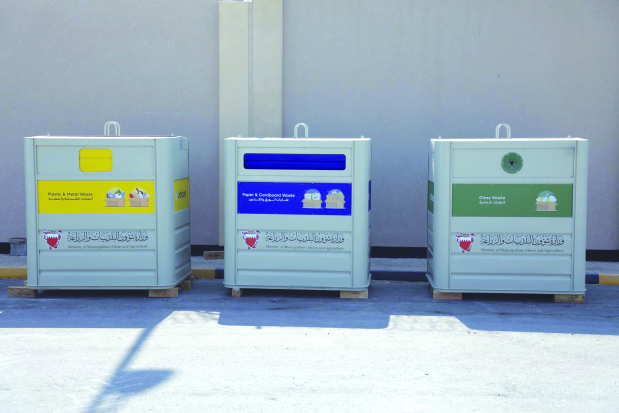
Three hundred recycling bins have been distributed throughout the kingdom’s four governorates this year, the Municipalities Affairs and Agriculture Ministry has confirmed.
According to the ministry Under-Secretary Shaikh Mohammed bin Ahmed Al Khalifa, at least 279 tonnes of recyclable waste were collected through sorting bins from January to October 2025.
The materials included 209 tonnes of paper and cardboard, 28 tonnes of plastic, 28 tonnes of glass, and 14 tonnes of metals.
Shaikh Mohammed stated that cleaning companies, in co-operation with local recycling firms and non-governmental organisations, are recycling the waste collected from these bins.
“These organisations ensure that materials are recycled according to their type and specialisation,” he said.

Shaikh Mohammed
“There is also a focus on enhancing the sorting processes and extracting the maximum possible amount of recyclable materials from mixed waste, thereby achieving the highest levels of efficiency in recycling operations.
“Separate containers for glass, plastic, metals, paper and cardboard have been set up in multiple areas across the four governorates and they are easily accessible to people.
“Special mechanisms have been introduced to help collect these waste from the recycling bins, contributing to easier sorting and faster processing operations.”

Around 279 tonnes of recyclable waste have been collected this year
The 1,100-litre plastic bins are characterised by high durability and light weight, which reduces noise during waste transport and removal, while also being environmentally friendly.
Shaikh Mohammed emphasised the importance of community partnerships in enhancing recycling and waste-treatment processes, ensuring that materials deemed unsuitable for use are converted into reusable resources.
He highlighted the promising environmental and economic returns, stating that these bins reduce the volume of waste sent to landfill, and represent a step forward towards achieving a circular economy in the kingdom.

Bins set up in the Capital Governorate
Additionally, he noted that the containers are equipped with advanced sensors, allowing them to be emptied multiple times in a single day if they reach capacity.
“Each container is tracked through an electronic system that records details of emptying operations, sanitisation and washing,” he said.
“It also monitors the movement of vehicles assigned to cleaning operations to ensure area coverage and maintain public cleanliness.”
Shaikh Mohammed revealed that work is ongoing to implement the National Waste Management Strategy, in co-ordination with the relevant government entities, through the continued development of waste management infrastructure in the kingdom. This initiative includes monitoring cleanliness standards, detecting violations and reducing waste volumes through source-level recycling.
The strategy, overseen by the Supreme Council for Environment, aims to achieve integrated, sustainable waste management through key initiatives like waste-to-energy, recycling and engineered landfills. Aligned with Bahrain’s Economic Vision 2030 and the Sustainable Development Goals, it targets significant landfill reduction by focusing on resource recovery and raising public awareness.
The kingdom has made visible efforts recently to encourage recycling and enhance public cleanliness. In July last year, the GDN reported that a staggering 1.4 million tonnes of domestic and commercial waste made its way to the Askar landfill site, which is about 1kg per person for each day.
Eight different types of waste were dumped in 2023, namely domestic, commercial, garden, industrial, fallen stock, tyres, building waste and liquids. As a result, the ministry had then said that it would begin the distribution of 300 recycling bins throughout the country in a bid to reduce waste and boost sustainability.
nader@gdnmedia.bh
&uuid=(email))