

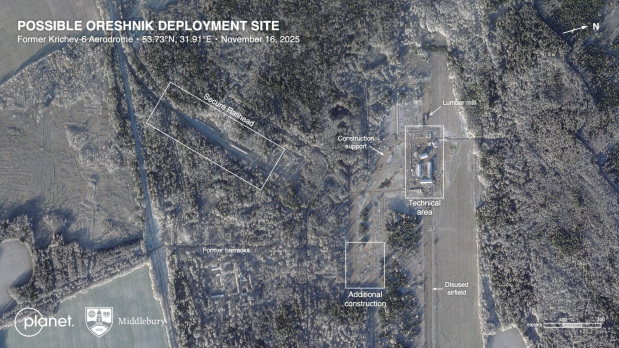
Moscow is likely stationing new nuclear-capable hypersonic ballistic missiles at a former airbase in eastern Belarus, a development that could bolster Russia’s ability to deliver missiles across Europe, two US researchers have found by studying satellite imagery.
The researchers’ assessment broadly aligns with US intelligence findings, said a person familiar with the matter who spoke on the condition of anonymity to share information not authorised for public release.
Russian President Vladimir Putin has made clear his intention to place intermediate-range Oreshnik missiles, with an estimated range of up to 5,500 km, in Belarus, but the exact location has not been previously reported.
Deployment of the Oreshnik would underscore the Kremlin’s growing reliance on the threat of nuclear weapons as it seeks to deter Nato members from supplying Kyiv with weapons that can strike deep inside Russia, some experts said.
The Russian Embassy in Washington did not immediately respond to a request for comment.
The Belarus Embassy declined to comment. The state-run Belta news agency quoted Defence Minister Viktor Khrenin on Wednesday as saying that the Oreshnik’s deployment would not alter the balance of power in Europe and was “our response” to the West’s “aggressive actions.”
The White House did not immediately respond to a request for comment and the CIA declined to comment.
Researchers Jeffrey Lewis of the Middlebury Institute of International Studies, in California, and Decker Eveleth of the CNA research and analysis organisation in Virginia, said they based their finding regarding the deployment of Oreshniks on imagery from Planet Labs, a commercial satellite firm, that showed features consistent with a Russian strategic missile base.
Lewis and Eveleth said they were 90 per cent certain that mobile Oreshnik launchers would be stationed at the former airbase near Krichev, some 307 km east of the Belarus capital of Minsk, and 478 km southwest of Moscow.
Moscow tested a conventionally armed Oreshnik – Russian for Hazel tree – against a target in Ukraine in November 2024. Putin boasts that it’s impossible to intercept because of velocities reportedly exceeding Mach 10.
Putin plans to deploy the weapon “in Belarus to extend its range further into Europe,” said John Foreman, an expert with the Chatham House who served as a British defence attache in Moscow and Kyiv.
Foreman said he also sees such a move as a reaction to the planned stationing in Germany next year by the US of conventional missiles that include the intermediate-range hypersonic Dark Eagle.
The Oreshnik’s deployment would come with only weeks left before the expiration of 2010 New START pact, the last US-Russia treaty limiting deployments of strategic nuclear weapons by the world’s biggest nuclear powers.
Putin said after a December 2024 meeting with his Belarusian counterpart, Alexander Lukashenko, that the Oreshnik could be stationed in Belarus in the second half of this year – part of a revised strategy in which Moscow is basing nuclear weapons outside its territory for the first time since the Cold War.
&uuid=(email))