

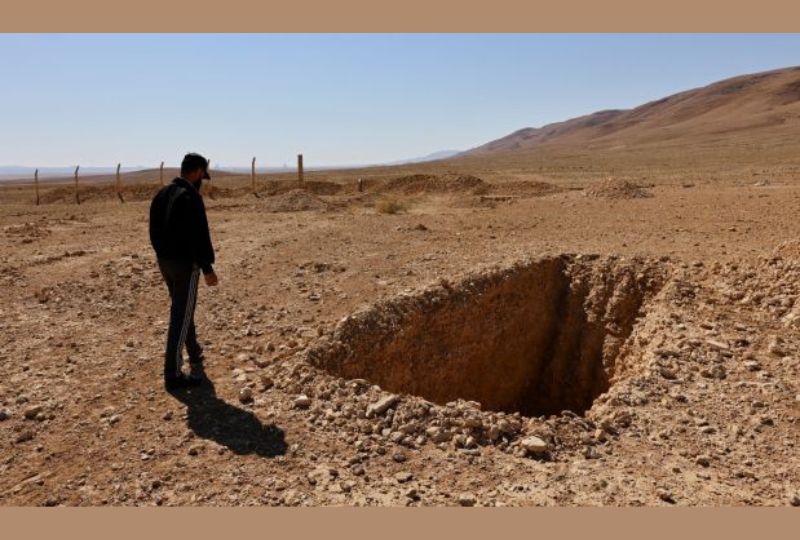
Syria’s government has ordered soldiers to guard a mass grave created to conceal atrocities under Bashar Al Assad and has opened a criminal investigation, following a Reuters report that revealed a yearslong conspiracy by the fallen dictatorship to hide thousands of bodies on the remote desert site.
The site, in the Dhumair desert east of Damascus, was used during Assad’s rule as a military weapons depot, according to a former Syrian army officer with knowledge of the operation.
It was later emptied of personnel in 2018 to ensure secrecy for a plot that involved unearthing the bodies of thousands of victims of the dictatorship buried in a mass grave on the outskirts of Damascus and trucking them an hour’s drive away to Dhumair.
The plot, orchestrated by the dictator’s inner circle, was called “Operation Move Earth.”
Soldiers are stationed at the Dhumair site again, this time by the government that overthrew Assad.
The Dhumair military installation was also reactivated as a barracks and arms depot in November, after seven years of disuse, according to an army officer posted there in early December, a military official and Sheikh Abu Omar Tawwaq, who is the security chief of Dhumair.
The Dhumair site was completely unprotected over the summer, when Reuters journalists made repeated visits after discovering the existence of a mass grave there.
Within weeks of the report in October, the new government created a checkpoint at the entrance to the military installation where the site lies, according to a soldier stationed there who spoke to Reuters in mid-December. Visitors to the site now need access permits from the Defence Ministry.
Satellite images reviewed by Reuters since late November show new vehicle activity around the main base area.
The military official, who spoke on condition of anonymity, said the reactivation of the base is part of efforts to “secure control over the country and prevent hostile parties from exploiting this open strategic area.” The road through the desert connects one of Islamic State’s remaining Syrian strongholds with Damascus.
In November, police opened an investigation into the grave, photographing it, carrying out land surveys and interviewing witnesses, according to Jalal Tabash, head of the Al Dhumair police station.
Among those interviewed by police was Ahmed Ghazal, a key source for the Reuters investigation that exposed the mass grave.
&uuid=(email))