

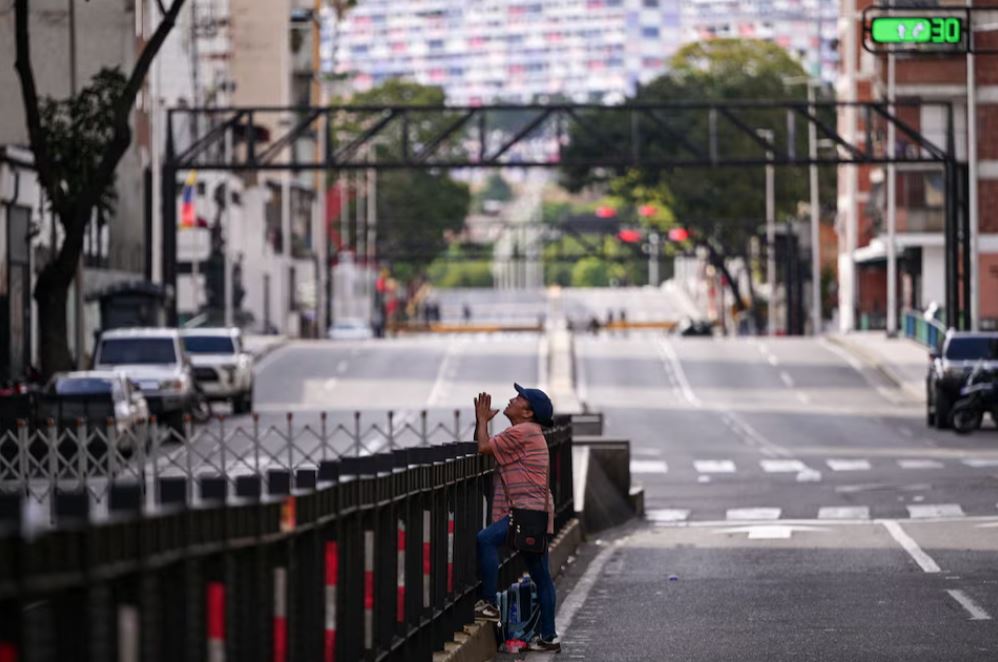
Secretary of State Marco Rubio said America is not at war with Venezuela, a day after the US military carried out air strikes on the country and captured its leader, Nicolas Maduro, and his wife.
On NBC’s Meet the Press Sunday, Rubio said the US is “at war against drug trafficking organisations,” not Venezuela itself.
“We don’t have US forces on the ground in Venezuela,” Rubio said.
When asked, though, about who’s running Venezuela now, he was more vague, saying that people keep “fixating on that.”
“Here’s the bottom line on it”.
“we expect to see changes in Venezuela, changes of all kinds, long term, short term. We’d love to see all kinds of changes, but the most immediate changes are the ones that are in the national interest of the US,” Rubio said. “That’s why we’re involved here, because of how it applies and has a direct impact on the US.”
Holding elections in Venezuela, he argued, is “premature at this point.”
On Saturday, after the strikes, US President Donald Trump, at a news conference said that the US is “going to run the country until such time as we can do a safe, proper and judicious transition.” Pressed about this on NBC, Rubio answered that “it’s running policy.”
“We want Venezuela to move in a certain direction because not only do we think it’s good for the people of Venezuela, it’s in our national interest,” Rubio said. “It either touches on something that’s a threat to our national security or touches on something that’s either beneficial or harmful to our national interest.”
Added Rubio: “This is a team effort by the entire national security apparatus of our country.”
He made the same point on ABC News’ This Week.
“What we are running is the direction that this is going to move moving forward. And that is we have leverage,” Rubio said.
The Trump administration has been criticised for the military operation in Venezuela, as it did not get Congress’ approval for it. Rubio denied that this was needed in Sunday morning show interviews, stating on ABC that “You can’t congressionally notify something like this for two reasons.”
“Number one, it will leak. It’s as simple as that. And number two, it’s an exigent circumstance. It’s an emergent thing,” Rubio said.
He maintained that the goal of the military’s actions were to stop drug trafficking in the US.
But House Minority Leader Hakeem Jeffries, D-NY, who was also interviewed on Meet The Press, said Saturday’s operation “was not simply a counternarcotics operation.”
“It was an act of war,” Jeffries said.
Jeffries said there’s been “no evidence that the administration has presented to justify the actions that were taken in terms of there being an imminent threat to the health, the safety, the well-being, the national security of the American people.”
Sen Tim Kaine, D-Va., a senior member of the Senate Armed Services Committee, said in a statement on Saturday he plans to force a vote on a bipartisan resolution declaring the US “should not be at war with Venezuela absent a clear congressional authorisation.”
During his Meet the Press interview, Rubio touched on Cuba, which he previously said should be “concerned” following what happened in Venzuela.
“The Cuban government is a huge problem, first of all, for the people of Cuba,” he said on NBC, though he declined to talk about what “future steps” would entail.
Still, he said “I don’t think it’s any mystery that we are not big fans of the Cuban regime, who, by the way, are the ones that were propping up Maduro.”
Trump on Saturday also addressed Cuba, saying that he thinks it’s “something we’ll end up talking about.”
“Cuba is a failing nation right now, a very badly failing nation, and we want to help the people,” he said.
In a statement on Saturday, Cuban President Miguel Diaz-Canel condemned the Venezuela strikes and Maduro’s arrest, calling it “an act of state terrorism.”
“It is a shocking violation of the norms of international law – the military aggression against a peaceful nation that poses no threat to the US,” he said.
A top Venezuelan official declared yesterday that the country’s government would stay unified behind President Nicolas Maduro, whose capture by the US has sparked deep uncertainty about what is next for the South American nation.
Maduro is in a New York detention centre awaiting a court appearance today on drug charges.
In Caracas, top officials in Maduro’s government, who have called the detentions of Maduro and his wife Cilia Flores a kidnapping, were still in charge.
“Here, the unity of the revolutionary force is more than guaranteed, and here there is only one president, whose name is Nicolas Maduro Moros. Let no one fall for the enemy’s provocations,” Interior Minister Diosdado Cabello said in an audio recording released by the ruling PSUV socialist party.
Images of the 63-year-old Maduro blindfolded and handcuffed on Saturday stunned Venezuelans. The operation was Washington’s most controversial intervention in Latin America since the invasion of Panama 37 years ago.
Without providing specifics, Defence Minister General Vladimir Padrino said on state television the US attack killed soldiers, civilians and a “large part” of Maduro’s security detail “in cold blood.” Venezuela’s armed forces have been activated to guarantee sovereignty, he said.
Vice President Delcy Rodriguez – who also serves as oil minister – has taken over as interim leader with the blessing of Venezuela’s top court, though she has said Maduro remains president.
Because of her connections with the private sector and deep knowledge of oil, the country’s top revenue source, Rodriguez has long been considered the most pragmatic member of Maduro’s inner circle. But she has publicly contradicted Trump’s claim she is willing to work with the US.
Trump said Rodriguez may pay a bigger price than Maduro “if she doesn’t do what’s right,” according to an interview with The Atlantic magazine yesterday.
&uuid=(email))