

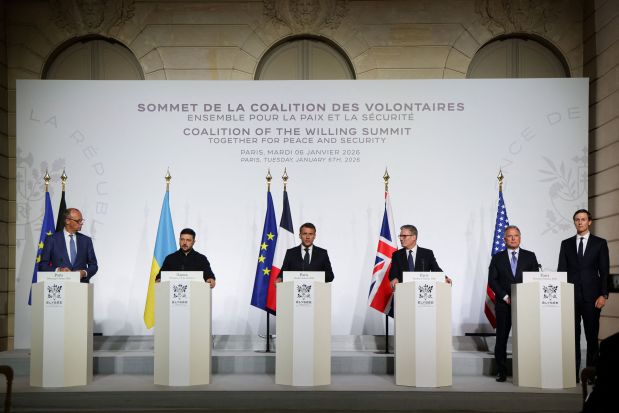
The United States for the first time yesterday backed a broad coalition of Ukraine’s allies in vowing to provide security guarantees that leaders said would include binding commitments to support the country if Russia attacks again.
The pledge came at a summit in Paris of the “coalition of the willing” of mainly European nations to firm up guarantees to reassure Kyiv in the event of a ceasefire with Russia, which invaded its neighbour in 2014 and again at full scale in 2022.
Unlike previous coalition meetings, the summit was also attended by US envoys
Steve Witkoff and Jared Kushner – President Donald Trump’s son-in-law – as well as America’s top general in Europe, Alexus Grynkewich, who a day earlier fleshed out details of security guarantees with European army chiefs. Witkoff, who has led talks with Russia, said after the summit that Trump “strongly stands behind security protocols”.
“Those security protocols are meant to ... deter any attacks, any further attacks in Ukraine, and ... if there are any attacks, they’re meant to defend, and they will do both. They are as strong as anyone has ever seen,” he said at a joint news conference with the French, German, British and Ukrainian leaders.
Kushner said that if Ukrainians were to make a final deal “they have to know that after a deal they are secure, they have, obviously, a robust deterrence, and there’s real backstops to make sure that this will not happen again.”
A statement by coalition leaders also said that allies will participate in a proposed US-led ceasefire monitoring and verification mechanism. Officials have said this would likely involve drones, sensors and satellites, not US troops.
The statement was not explicitly endorsed by the United States and details of a US role were watered down from an earlier draft, notably removing language that outlined the use of US capabilities to support a multinational force in Ukraine.
But European officials hailed the involvement of the US envoys and their strong comments as evidence Washington stood behind the security framework.
Talks to bring the almost four-year war to an end have accelerated since November. However, Moscow has yet to signal willingness to make concessions after Kyiv pushed for changes to a US proposal that initially backed Russia’s main demands.
Moscow has also given no public sign that it would accept a peace deal with the security guarantees envisaged by Ukraine’s allies. Russia has previously rejected any Nato members having troops inside Ukraine.
&uuid=(email))