

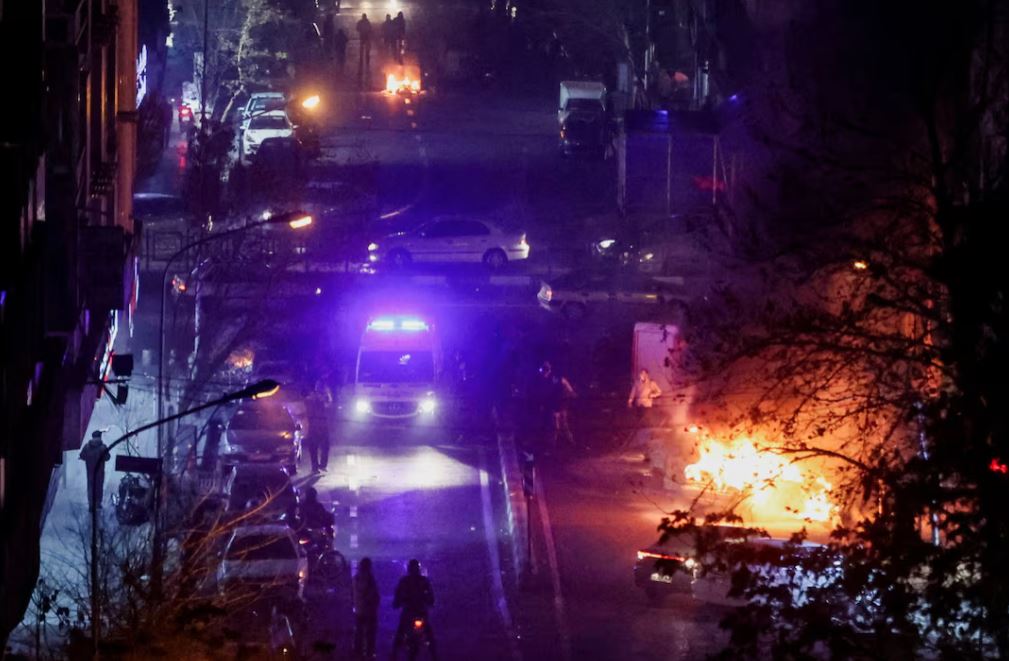
Tehran said yesterday it is keeping communications open with the US as President Donald Trump weighed responses to a deadly crackdown on nationwide protests in Iran, which pose one of the stiffest challenges to clerical rule since the 1979 Islamic Revolution.
Trump said on Sunday the US may meet Iranian officials and he was in contact with Iran’s opposition, while piling pressure on its leaders, including threatening possible military action over lethal violence against protesters.
While air strikes were one of many alternatives open to Trump, “diplomacy is always the first option for the president,” White House Press secretary Karoline Leavitt told reporters yesterday.
“What you’re hearing publicly from the Iranian regime is quite different from the messages the administration is receiving privately, and I think the president has an interest in exploring those messages,” she said.
Iran’s leaders, their regional clout much reduced, are facing fierce demonstrations that evolved from complaints about dire economic hardships to defiant calls for the fall of the deeply entrenched clerical establishment.
Despite the massive scale of the protests, there are no signs of splits in the Shi’ite clerical leadership, military or security forces, and demonstrators have no clear central leadership. The opposition is fragmented.
Iran has not given an official death toll, but blames the bloodshed on US interference and what it calls Israeli- and US-backed terrorists. State-run media has focused attention on the deaths of security forces.
Iran’s Ministry of Intelligence said yesterday it had detained “terrorist” teams responsible for acts including killing paramilitary volunteers loyal to the clerical establishment, torching mosques and attacking military sites, according to a statement carried by state media.
Iranian Foreign Minister Abbas Araqchi said Tehran was studying ideas proposed by Washington, though these were “incompatible” with US threats. “Communications between (US special envoy Steve) Witkoff and me continued before and after the protests and are still ongoing,” he said.
The ambassadors of Britain, Italy, Germany and France in Tehran were summoned to the foreign ministry, semi-official Tasnim news agency reported yesterday, and asked to relay Tehran’s request to withdraw their support for the protests to their governments.
A French diplomatic source said the ambassadors had strongly expressed their concerns.
Trump said on Sunday that Iran had called to negotiate about its disputed nuclear programme.
Israel and the US bombed Iranian nuclear sites in a 12-day war in June.
“A meeting is being set up, but we may have to act because of what is happening before the meeting,” he told reporters on Air Force One.
Trump was to meet with senior advisers today to discuss options for Iran, a US official told Reuters. The Wall Street Journal reported that the options included military strikes, using secret cyber weapons, widening sanctions and providing online help to anti-government sources.
Striking military installations could be highly risky, as some may be located in heavily populated areas.
Tehran is still recovering from last year’s war, and its regional clout has been weakened by blows to allies such as Lebanon’s Hizbollah since the October 7, 2023, attack on Israel. Israel also killed top Iranian military commanders in the June war.
&uuid=(email))