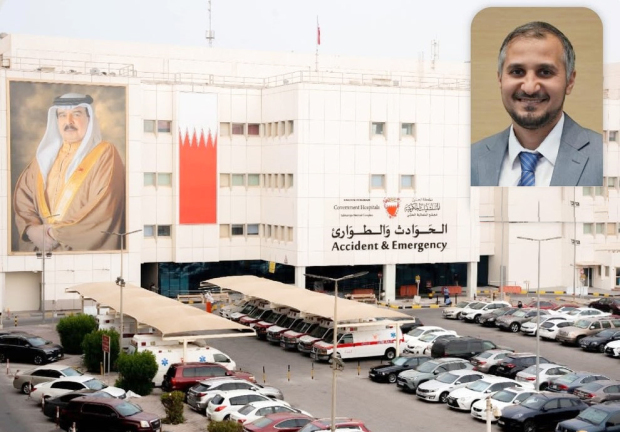
A new technique considered to be one of the most advanced surgical methods for the treatment of a painful and potentially dangerous medical condition has been performed at the kingdom’s largest community hospital with resounding success.
An inguinal hernia, more common in men, is a bulge in the groin from abdominal tissue pushing through a weak spot in the lower abdominal wall, often appearing as a lump that may hurt when coughing, bending, or lifting, requiring potential surgery as it won’t heal on its own and can lead to serious complications like strangulation if untreated.
The first laparoscopic inguinal hernia repair in Bahrain, using the innovative totally extraperitoneal (TEP) technique, was recently successfully performed on multiple patients at the Salmaniya Medical Complex (SMC). It helps to reduce complications and accelerate the recovery period, enabling the patient to return to normal daily activities within a short time.
The surgeries were carried out by a team led by Dr Ahmed Al Saeed, who is a Consultant General Surgeon and Advanced Laparoscopic and Colorectal Surgeon. Speaking to the GDN, Dr Al Saeed stated that the procedure reflects a major step forward for not just SMC, but Bahrain’s medical sector as a whole.
“We are delighted to bring this procedure, which is standard only in leading centres around the world, into our public healthcare system” he said. “We have done this operation for a few patients over the past number of months, and have had some very good results with high satisfaction.
“Introducing this procedure is a major milestone in elevating the hospital’s efficiency and medical capabilities. It builds a strong, highly-trained surgical team, provides hands-on learning for trainees and nursing staff, and enhances the team’s skill in minimally invasive and advanced laparoscopic techniques.”
The technique is considered one of the most advanced surgical methods for the treatment of inguinal hernias, as it helps to reduce complications and accelerate the recovery period, enabling the patient to return to normal daily activities within a short time.
TEP uses three very small incisions, one of which is 1cm, and the others being 0.5 cm, above the peritoneum (a membrane lining the cavity of the abdomen and covering the abdominal organs) without the need to go through the abdominal cavity.
A mesh is placed over the hernia defect, reducing risks like bowel injury and adhesions compared to internal approaches.
Dr Al Saeed said that this technique does not just benefit patients, but it also helps the hospital’s nursing teams as well, reducing the time and effort spent on postoperative wound management.
“Most patients are able to walk within hours, eat normally soon after surgery, and return home the same day or the following morning at the latest,” he said. “Compared with traditional open surgery, recovery is much faster and patients are able to go back to work and normal life sooner and with greater comfort.
“From a clinical standpoint, TEP reduces postoperative workload on doctors and nurses and improves the overall patient experience and satisfaction.
“The introduction of TEP has translated into better surgical quality, lower complication rates, reduced risk of reoccurrence and a lower likelihood of adhesion and chronic groin pain often associated with open repairs.”
Finally, Dr Al Saeed expressed his pride in being able to offer the procedure, not only because the surgery is more efficient, but also because it contributes to a stronger healthcare system and better value for the community.
“Adopting TEP enhances our hospital’s reputation,” he said. “Only a limited number of centres worldwide are able to offer this level of care.
“We believe this positions our institution as a leader in modern surgical practice, not only in the region but internationally.
“Although the technique requires skilled hands and careful training, early results from the cases we have performed are very encouraging.
“Our goal is for this success to pave the way for further innovation, including robotic surgery in the near future.”
nader@gdnmedia.bh