

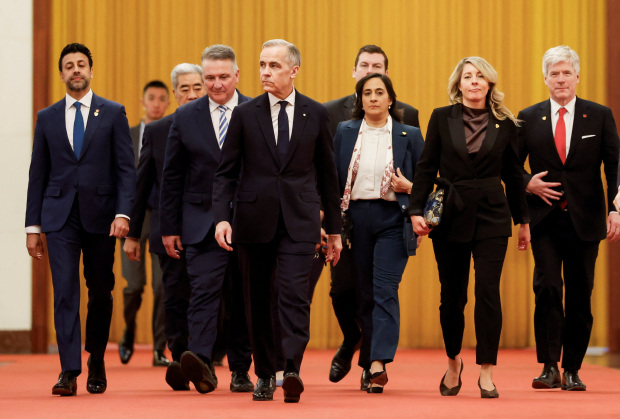
Canada and China have struck an initial trade deal that will slash tariffs on electric vehicles and canola, Prime Minister Mark Carney said yesterday, as both nations promised to tear down trade barriers while forging new strategic ties.
The first Canadian prime minister to visit China since 2017, Carney is seeking to rebuild ties with his country’s second-largest trading partner after the United States following months of diplomatic efforts.
Canada will initially allow in up to 49,000 Chinese electric vehicles at a tariff of 6.1 per cent on most-favoured-nation terms, Carney said after talks with Chinese leaders including President Xi Jinping. He did not specify a time period.
That compares with the 100pc tariff on Chinese electric vehicles imposed by the government of former Prime Minister Justin Trudeau in 2024, following similar US penalties. In 2023, China exported 41,678 EVs to Canada.
“This is a return to levels prior to recent trade frictions, but under an agreement that promises much more for Canadians,” Carney told reporters.
Trudeau justified his tariff on the grounds that there was an unfair global market edge for Chinese manufacturers benefiting from state subsidies, a scenario that threatened domestic producers.
“For Canada to build its own competitive EV sector, we will need to learn from innovative partners, access their supply chains, and increase local demand,” Carney said.
He pointed to a stronger partnership with China in clean energy storage and production, driving new investments.
Carney said he expected the EV pact would drive “considerable” Chinese investment into Canada’s auto sector, create good careers and speed it towards a net zero future.
Doug Ford, premier of Ontario, Canada’s main auto manufacturing province, complained China now had a Canadian foothold and would take full advantage.
“The federal government is inviting a flood of cheap made-in-China electric vehicles without any real guarantee of equal or immediate investments in Canada’s economy, auto sector or supply chain,” he said in a post on X.
Last March, in retaliation for Trudeau’s tariffs, China levied tariffs on more than $2.6 billion of Canadian farm and food products such as canola oil and meal, followed by tariffs on canola seed in August.
That led to a slump of 10.4pc in China’s 2025 imports of Canadian goods.
Under the new deal, Carney said, Canada expects China will lower tariffs on its canola seed by March 1, to a combined rate of about 15pc.
“This change represents a significant drop from current combined tariff levels of 84pc,” he said, adding China was a $4bn canola seed market for Canada.
Canada also expects its canola meal, lobsters, crabs and peas to have anti-discrimination tariffs removed from March 1, until at least year-end, he added.
The deals will unlock nearly $3bn in export orders for Canadian farmers, fish harvesters and processors, Carney said.
He also said Xi had committed to ensuring visa-free access for Canadians travelling to China, but did not give details.
In a statement announced by China’s state-run Xinhua news agency, the two nations pledged to restart high-level economic and financial dialogue, boost trade and investment, and strengthen co-operation in agriculture, oil, gas and green energy.
Carney said Canada will double its energy grid over the next 15 years, adding there were opportunities for Chinese partnership in investments including offshore wind.
He also said Canada was scaling up its LNG exports to Asia and will produce 50 million tonnes of LNG each year – all destined for Asian markets by 2030. “Given current complexities in Canada’s trade relationship with the US, it’s no surprise that Carney’s government is keen to improve the bilateral trade and investment relationship with Beijing, which represents a massive market for Canadian farmers,” said Beijing-based Trivium China’s Even Rogers Pay.
“Meanwhile, it’s difficult for Washington to criticise Carney for striking a beneficial trade deal when Trump himself just did so in October.”
US President Donald Trump has also imposed tariffs on some Canadian goods and suggested the longtime US ally could become his country’s 51st state.
China, similarly hit by Trump’s tariffs, is keen to co-operate with a Group of Seven nation in a traditional sphere of US influence.
&uuid=(email))