

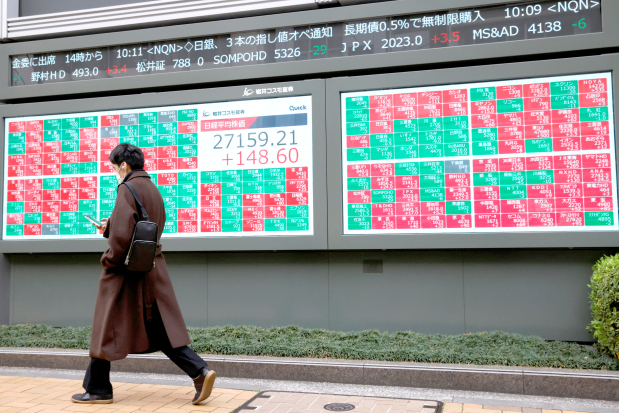
GLOBAL stocks dropped and the dollar eased against the safe-haven yen and Swiss franc yesterday after US President Donald Trump threatened additional tariffs on goods imported from European nations that oppose his planned takeover of Greenland.
Gold and silver prices jumped to new record peaks, while oil dipped on concerns about what a possible trade war between the US and Europe could mean for global growth and demand.
US cash equity markets were closed yesterday for Martin Luther King Jr Day, although S&P 500 and Nasdaq futures both dropped over 1.2 per cent.
In Europe, the STOXX 600 index fell 1.2pc. Blue-chip indexes in Frankfurt, Paris and London were down 0.4pc to 1.7pc.
Japan’s Nikkei fell 0.7pc, and MSCI’s broadest index of Asia-Pacific shares outside Japan was little changed.
Trump said he would impose additional 10pc levies from February 1 on goods imported from Denmark, Norway, Sweden, France, Germany, the Netherlands, Finland and Britain, rising to 25pc on June 1 if no deal on Greenland was reached.
Major European Union states condemned the tariff threats as blackmail, and France proposed responding with a range of previously untested economic countermeasures. The EU and Britain had agreed trade deals with the US last year.
“There is obviously a response (in financial markets) to the new tariff threats,” said George Lagarias, chief economist at Forvis Mazars.
“It’s highly likely that the White House will use the threat of tariffs consistently, even when deals have previously been agreed.”
The EU’s retaliation options include a package of its own tariffs on 93 billion euros ($108bn) of goods imported from the US that was suspended for six months in early August, and measures under an Anti-Coercion Instrument that could hit US services trade or investments.
The tariff threats should also make for a fraught few days at Davos as leaders from around the world gather in Switzerland at the World Economic Forum, including a large US group led by Trump.
In currency markets, the euro recovered from a seven-week low, rising 0.4pc to $1.1641.
“The market reaction that we have seen so far is more on the back of the geopolitical risk than the tariff threat,” said Tommy von Brömsen, FX strategist at Handelsbanken.
“Typically you see dollar strength in the wake of increased geopolitical risk but now we see dollar weakness as it is originating from the US,” von Brömsen said, adding that the uncertainty could cause investors to diversify away from US assets.
Sterling clawed its way back up to $1.3422 after initially dipping in Asian trade, while safe-haven currencies also rose. The dollar eased 0.7pc to 0.7965 Swiss francs , and 0.2pc to 157.88 yen.
Investors largely shrugged off an announcement from Japanese Prime Minister Sanae Takaichi to dissolve parliament on Friday ahead of a snap general election to be held on February 8, as she looks to shore up her coalition’s fragile majority.
“The Bank of Japan’s response will be critical, given PM Takaichi’s expressed preference for cooperation and softened central bank independence,” said Scotiabank chief FX strategist Shaun Osborne.
The BoJ meets on Friday and is widely expected to maintain its policy rate at 0.75pc after a rate hike in December.
The dollar index, which measures the currency against six peers, was lower yesterday.
The cash US Treasury market was shut, but 30-year bond futures fell 19 ticks.
Gold again proved to be a safe harbour, rising as high as $4,689 an ounce, while silver climbed to $94.08.
China’s blue chips were little changed after data showed annual economic growth slowed to 4.5pc in the December quarter, though that still topped forecasts.
Industrial output also beat market expectations thanks to strength in exports, but disappointing retail sales underlined weak domestic demand.
Oil prices were little changed as civil unrest in Iran subsided, with the market also tracking the demand picture should the trade war over Greenland escalate.
Brent was down just 0.1pc at $64.04 a barrel, while US crude was flat at $59.41.
Meanwhile, most Gulf stock markets ended higher yesterday as regional geopolitical tensions eased, while Saudi Arabia’s benchmark index finished flat amid soft oil prices and profit-taking.
Dubai’s main share index advanced 0.4pc, with blue-chip developer Emaar Properties rising 1pc and Sharia-compliant lender Dubai Islamic Bank advancing 1.4pc.
In Abu Dhabi, the benchmark index finished 0.5pc higher. In the UAE, equities extended last week’s gains, underpinned by optimism around the earnings season.
Both Dubai and Abu Dhabi posted broad-based advances, supported by solid fundamentals and expectations of strong results, though oil-price swings remain a key risk for sentiment, said Milad Azar Market analyst at XTB Mena.
The Qatari index gained 0.7pc, led by a 1.5pc gain in petrochemical maker Industries Qatar. Saudi Arabia’s benchmark index concluded flat. Traders are awaiting further fourth-quarter earnings releases this week as the season kicks off. While the market relies on solid economic fundamentals and a 4.5pc growth projection for 2026, volatile oil prices and geopolitical uncertainty continue to pose risks, said Azar.
Outside the Gulf, Egypt’s blue-chip index leapt 2.5pc, closing at an all-time high, as most of the stocks were in positive territory.
&uuid=(email))