

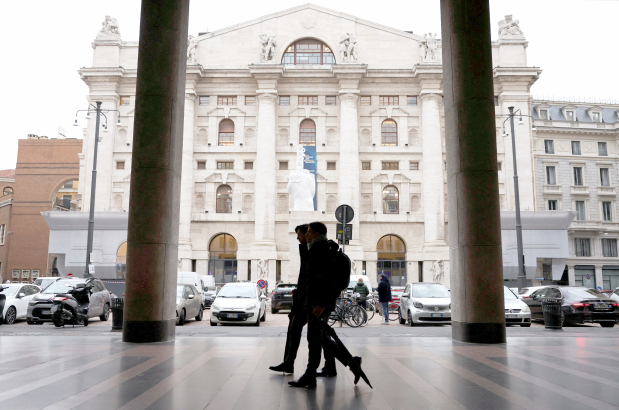
Global stocks were lower across board yesterday, with a selloff in equities on Wall Street, Europe and Asia, amid heightened market volatility after US President Donald Trump threatened to reignite a trade war with Europe over Greenland.
Trump said he no longer thought “purely of peace” after he did not win the Nobel Peace Prize and reiterated a threat to increase tariffs on EU members Denmark, Finland, France, Germany, Sweden, and the Netherlands, along with Britain and Norway, until the US is allowed to buy Greenland.
EU leaders will discuss options, including tariffs worth 93 billion euros ($109bn) on US imports, at an emergency summit in Brussels tomorrow.
“The geopolitical risks that we’ve been talking about for a long time are re-emerging and are shifting market perceptions of common alliances across allies in Europe,” said Wasif Latif, chief investment officer at Sarmaya Partners in New Jersey.
“That is couple with what’s going on in Japan with the JGB yields continuing to rise and the market caught at the sleep at the wheel on that risk that’s out there. So it’s all coming together for a pretty significant risk off day.”
The Dow Jones Industrial Average fell 1.39 per cent, the S&P 500 fell 1.39pc and the Nasdaq Composite fell 1.64pc. Europe’s STOXX 600 was down 1pc on the day, having already fallen 1.2pc on Monday, while the MSCI World Equity Index was down 1.16pc. The FTSE 100 was down 1pc. MSCI’s broadest index of Asia-Pacific shares outside Japan closed lower by 0.62pc, while Japan’s Nikkei fell 1.11pc. Japanese government bonds (JGBs) plunged, sending yields to record highs, after Prime Minister Sanae Takaichi’s calling of a snap election shook confidence in the country’s fiscal health.
“But we have to take all this with a grain of salt because what we’ve seen in prior times is that we get a risk off and a selloff like this and the Trump administration and the powers that be walk things back and calm things down,” Latif added.
Amelie Derambure, senior multi-asset portfolio manager at Amundi in Paris, said that the downward move in markets was “precautionary profit-taking and some risk reduction,” but that markets were helped by the macroeconomic backdrop. The euro was up 0.68pc against the dollar at $1.1724, having earlier hit its highest since January 2. The Japanese yen strengthened 0.08pc against the greenback to 157.99 per dollar. The dollar index was down 0.56pc at 98.526 heading for its second day of declines.
US Treasury yields hit their highest since September in early trading. US markets were closed on Monday for a public holiday, so the moves were a delayed reaction to the developments that began over the weekend. The yield on benchmark US 10-year notes rose 5.2 basis points to 4.283pc. The yield curve between 2-year and 10-year US Treasuries, and between 10-year and 30-year US Treasuries, steepened by the most since October . The yield on the benchmark German 10-year Bunds rose 2.6 basis points to 2.867pc.
Oil prices edged higher, with Brent crude futures up 1.56pc at $64.95 a barrel and US West Texas Intermediate up 1.95pc at $60.6 a barrel.
Gold hit a record high, rising above $4,700 an ounce. It was last up rose 1.61pc to $4,744.86 an ounce.
Spot silver slipped 1.16pc to $94.42/oz, after hitting a record $95.87 earlier.
&uuid=(email))