

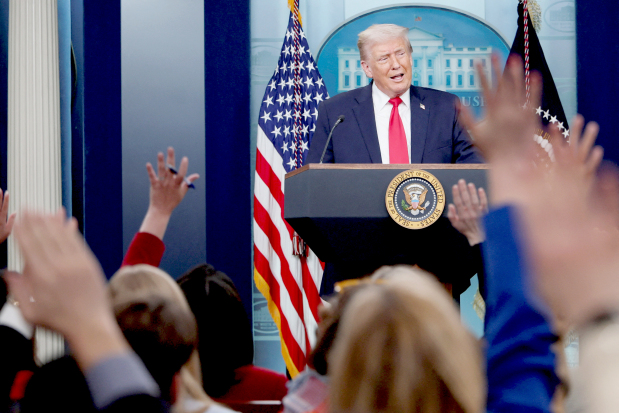
US President Donald Trump said yesterday there was ‘no going back’ on his goal to control Greenland, refusing to rule out taking the Arctic island by force and rounding on allies as European leaders struggled to respond.
Trump’s ambition – spelled out in social media posts and mock-up AI images – to wrest sovereignty over Greenland from fellow Nato member Denmark has threatened to blow apart the alliance that has underpinned Western security for decades.
It has also threatened to reignite a trade war with Europe that rattled markets and companies for months last year, though Trump’s Treasury Secretary Scott Bessent pushed back against what he called ‘hysteria’ over Greenland.
“As I expressed to everyone, very plainly, Greenland is imperative for National and World Security. There can be no going back – On that, everyone agrees!” Trump said after speaking to Nato Secretary General Mark Rutte.
To drive home the message, Trump posted an AI image of himself in Greenland, holding a US flag. Another showed him speaking to leaders next to a map showing Canada and Greenland as part of the United States.
Separately, he leaked messages including from French President Emmanuel Macron, who questioned what Trump was ‘doing on Greenland’. Trump, who has vowed to impose tariffs on countries that stood in his way, had earlier threatened to hammer French wines and champagnes with a 200 per cent tariff.
Danish Prime Minister Mette Frederiksen said she would not yield to Trump’s demands.
“I am certainly not going to abandon Greenland, I made that decision a long time ago as Danish prime minister,” she told reporters in Copenhagen.
“The American president has unfortunately not ruled out the use of military force. And therefore the rest of us cannot rule it out either, so it is a natural consequence of what the American president has said and has not said,” she added.
An agreement on sharing responsibility for the security of the Arctic and the North Atlantic could offer a way out of the stand-off, Lithuanian President Gitanas Nauseda told Reuters at the World Economic Forum in the Swiss ski resort of Davos.
Also speaking in Davos, Canadian Prime Minister Mark Carney said his country strongly opposed the imposition of any US tariffs linked to the Greenland issue. European leaders took to the stage in Davos attempting to project the continent’s strength, though it was not immediately clear how the European Union will eventually respond.
Some spoke of the importance of reducing European dependence for security on the United States. European Commission President Ursula von der Leyen described a ‘seismic change’ that made it necessary to build a ‘new form of European independence’.
The EU has threatened to hit back against the US with trade measures. One option is a package of tariffs on 93 billion euros ($109bn) of US imports that could automatically kick in on February 6 after a six-month suspension.
Another option is the ‘Anti-Coercion Instrument’ (ACI), known informally as the EU’s ‘trade bazooka’, which allows tough measures against countries that try to use trade to influence European policy. It has never yet been used, but Macron, who has raised the prospect of invoking it, insisted again yesterday that it was on the table.
It could limit access to public tenders, investments or banking activity, or restrict trade in services, the sector in which the US has a surplus with the bloc, including the lucrative digital services provided by US tech giants.
Treasury Secretary Bessent, also speaking at the Davos gathering of the world’s political and business elite, said a solution would be found that ensures national security for the United States and Europe.
“It’s been 48 hours. As I said, sit back, relax,” he said. “I am confident that the leaders will not escalate and that this will work out in a manner that ends up in a very good place for all.”
The foreign minister of Russia, which has been watching with glee as Trump’s drive to acquire Greenland widens splits with Europe, said that ‘Greenland is not a natural part of Denmark’ and also denied that Moscow had any designs on the island.
“It was neither a natural part of Norway nor a natural part of Denmark,” Sergei Lavrov told reporters in Moscow.
“It is a colonial conquest. The fact that the inhabitants are now accustomed to it and feel comfortable is another matter.”
Trump’s renewed tariff threats against European allies have revived talk of the ‘Sell America’ trade that emerged in the aftermath of his sweeping levies last April.
Wall Street’s main indexes opened sharply lower yesterday. In a sign of global risk aversion, gold prices touched record highs, stocks across the world slid and US Treasuries were sold off.
l Trump said yesterday he was considering involving Venezuelan opposition leader Maria Corina Machado in some capacity in her country, but did not say what role she could play.
“We’re talking to her and maybe we can get her involved some way. I’d love to be able to do that; Maria, maybe we can do that,” Trump told reporters at the White House, referring to Machado, who met Trump last week and gave him her Nobel Peace Prize.
Trump’s comments marked a tone change for the president, who previously questioned Machado’s popularity and ability to lead in Venezuela after the United States captured President Nicolas Maduro in a raid earlier this month. In 2024, Machado’s party said it had won 70 per cent of the vote in the presidential election.
“I felt so strongly against Venezuela, now I’m loving Venezuela. They’ve been working with us so well. It’s been so nice,” Trump told reporters, referring to his administration working with Venezuela’s interim president, Delcy Rodriguez.
&uuid=(email))