

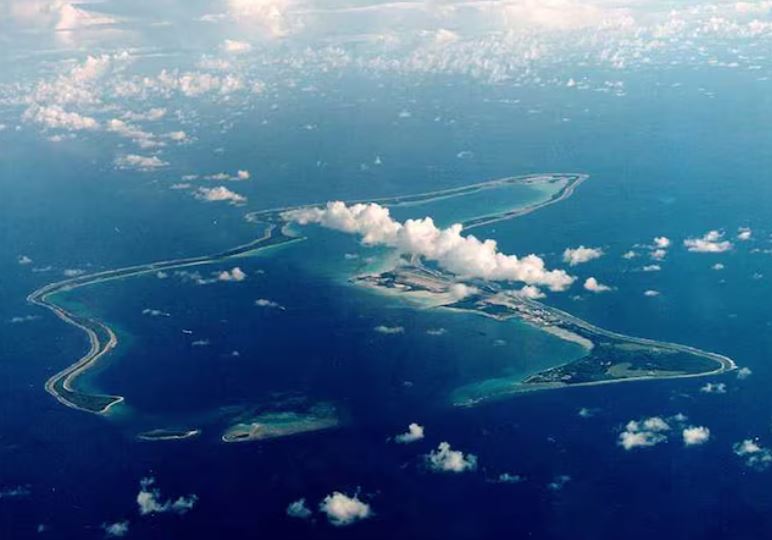
US President Donald Trump lambasted Britain’s deal to cede sovereignty of the Chagos Archipelago – including an island with an important US-UK air base – as an act of ‘total weakness’ and ‘great stupidity’ that underlines why he wants to acquire Greenland.
Washington last year gave its blessing to the deal, which gave the Indian Ocean islands to Mauritius but retained UK control of the Diego Garcia base under a 99-year lease.
But Trump reversed that with a typically blunt Truth Social post saying: “Shockingly, our ‘brilliant’ Nato Ally, the United Kingdom, is currently planning to give away the Island of Diego Garcia, the site of a vital US Military Base, to Mauritius, and to do so FOR NO REASON WHATSOEVER.”
He added: “There is no doubt that China and Russia have noticed this act of total weakness ... The UK giving away extremely important land is an act of GREAT STUPIDITY, and is another in a very long line of National Security reasons why Greenland has to be acquired.”
Trump’s attack heaps new strain on relations with Prime Minister Keir Starmer, who this week spoke out against his ambition to take over Greenland by any means to counter the encroaching presence of rivals China and Russia.
Responding to Trump’s Chagos comments, the British government said the deal was made precisely for national security reasons. “We acted because the base on Diego Garcia was under threat after court decisions undermined our position and would have prevented it operating as intended in future,” a spokesperson said.
The Chagos’ six main atolls, among more than 600 islands, lie 500km south of the Maldives and halfway between Africa and Indonesia, with about 4,000 people stationed there.
Britain forcibly displaced up to 2,000 indigenous Chagossians in the late 1960s and 1970s to establish the base on the Diego Garcia atoll, but has given sovereignty to former colony Mauritius which it is paying 101 million pounds ($136m) per year to secure the installation.
Responding to Trump’s remarks, Mauritius Attorney General Gavin Glover said that his country’s sovereignty over the archipelago had been unequivocally recognised by international law, and it ‘should no longer be subject to debate’.
&uuid=(email))