

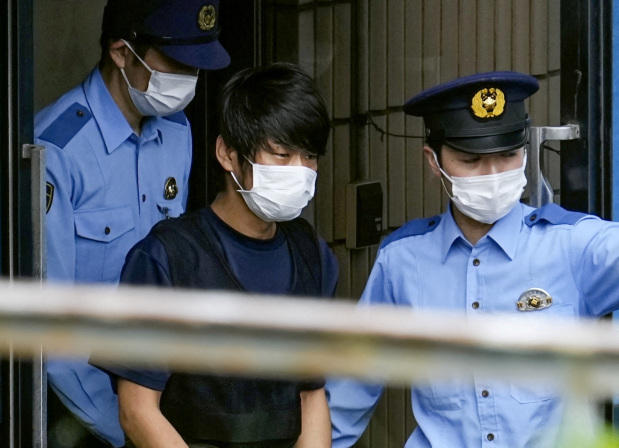
A Japanese court on Wednesday sentenced a 45-year-old man to life imprisonment for fatally shooting former Prime Minister Shinzo Abe in an incident that stunned the nation three and a half years ago.
Tetsuya Yamagami was arrested on the spot in July 2022 after fatally firing at Abe with a homemade gun while he was delivering a campaign speech in the western city of Nara. Abe, the country's longest-serving premier, was 67.
A guilty verdict was all but certain after Yamagami admitted to killing Abe in the first hearing at the Nara District Court in October, and attention had been on the severity of the sentence.
In handing down the sentence, Judge Shinichi Tanaka called the shooting "despicable" and said, "It is clear that using a gun in a large crowd is an extremely dangerous and malicious crime," according to public broadcaster NHK.
Prosecutors sought a life sentence, calling the shooting an "extremely grave incident that is unprecedented in post-war history". The defence argued for a lesser sentence of no more than 20 years, citing family issues linked to the Unification Church which motivated the shooting.
Although he was no longer Japan's leader at the time, Abe remained a powerful and binding force within the ruling Liberal Democratic Party. His absence has left a vacuum within the party, which has since seen two leadership races and by extension, a revolving door of prime ministers.
Abe himself served as prime minister for a total of 3,188 days over two separate terms, stepping down in September 2020 citing health reasons.
His protegee Sanae Takaichi now leads Japan and the LDP, but the party's grip on power has considerably diminished.
UNIFICATION CHURCH LINK
Abe's killing also brought to light a deep link between his party and the Unification Church, an organisation many consider a cult. An in-party investigation found that more than a hundred lawmakers had dealings with the group, leading many voters to shun the LDP, which has ruled Japan for most of the post-war period.
Media have quoted Yamagami as telling the court that he held a grudge against the Unification Church after his mother's large donation to it caused financial hardship for their family, and that he took out his anger on Abe because the former prime minister had once sent a video message to an event held by a group affiliated with the church.
Founded in South Korea in 1954, the Unification Church is famous for its mass weddings and counts Japanese followers as a key source of income.
While Abe was a divisive figure domestically, he was among the few global leaders to have a strong rapport with U.S. President Donald Trump.
Abe was the first foreign leader to meet Trump after his 2016 election victory and the two went on to forge a close bond over rounds of golf in the United States and Japan. Prime Minister Takaichi has repeatedly referenced their friendship in her own dealings with Trump.
&uuid=(email))