

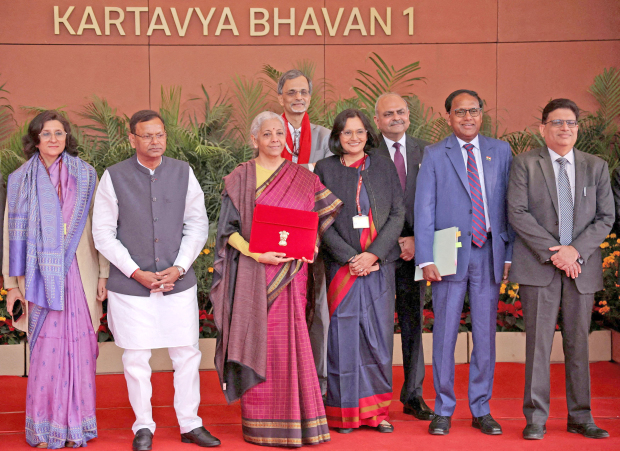
India pushed manufacturing to the forefront of its budget as it prioritised sectors such as semiconductors, biopharma and renewables, but stopped short of the bold reforms sought by investors to boost investment amid rising geopolitical tensions.
The absence of ambitious reforms and an increase in the transaction tax on derivatives spooked equity markets, which tumbled nearly two per cent for their worst budget-day performance in six years.
The Indian economy has so far weathered the 50pc US tariff on some Indian goods and geopolitical flux, with gross domestic product growth expected at 7.4pc in the financial year ending March 31, 2026.
But foreign investors have sold a record amount of Indian equities, adding up to $22 billion since last January, and the rupee has weakened sharply to all-time lows.
Economists and a rating agency said that yesterday’s budget for next fiscal year lacked firepower to buoy markets and was not a “breakthrough”.
“I think what we saw was a very tactical budget. It wasn’t a breakthrough kind of budget where groundbreaking kinds of measures were announced,” said Christian de Guzman, senior vice-president at Moody’s Ratings.
Finance Minister Nirmala Sitharaman cut tariffs on capital goods and doubled the budget for an electronics manufacturing scheme to 400 billion rupees ($4.3bn).
Sitharaman also announced foreign companies like Apple can freely provide machines to their contract manufacturers, removing any tax risk.
The finance minister committed to scaling up manufacturing priorities in seven sectors including pharmaceuticals, semiconductors, rare-earth magnets, capital goods and textiles.
Trideep Bhattacharya, president and CIO-Equities at Edelweiss Asset Management, said that while the budget provides some support for manufacturing, it “stopped short of the firepower that could have delivered immediate excitement to the markets.”
The Nifty 50 fell 1.96pc to 24,825.45, while the BSE Sensex lost 1.88pc to 80,722.94.
Market sentiment was also hit by a hike in the securities transaction tax by more than 50pc on futures trading to 0.05pc from 0.02pc and to 0.15pc from 0.01pc on options.
Indian bond and forex markets were closed yesterday.
The government raised the capital spending to 12.2 trillion rupees ($133.08 billion) from the current revised estimate of about 11trn rupees, in an environment where private investment remains tentative.
To shield the economy from punitive US tariffs imposed by President Donald Trump, the government has already started taking a number of steps including consumption-boosting tax cuts and a landmark trade agreement with the European Union.
Late last year, it also overhauled labour laws and opened up the tightly controlled nuclear-power sector.
The government raised its total spending to 53.5trn rupees from 49.6trn rupees, and set the fiscal deficit target at 4.3pc of GDP from the current year’s aim of 4.4pc of GDP.
Defence spending rose a modest 6pc and did not meet expectations of a 20pc increase.
To strengthen government finances New Delhi will aim to bring down federal government debt-to-GDP to 55.6pc in the next financial year from 56.1pc.
It will borrow 17.2trn Indian rupees from the bond markets.
&uuid=(email))