

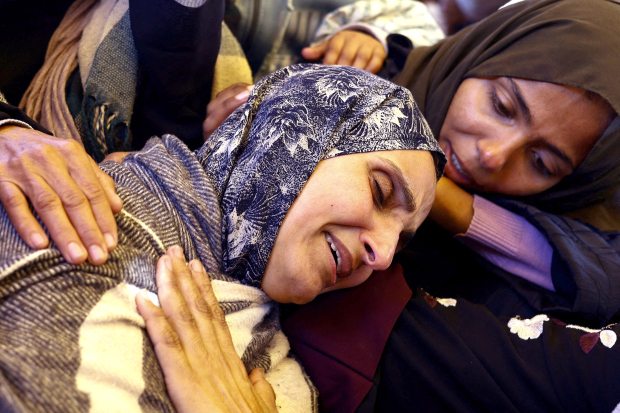
Israeli tank shelling and air strikes killed 24 Palestinians, including seven children, in Gaza yesterday, health officials said, the latest violence to undermine the nearly four-month-old ceasefire in the enclave.
Among the dead was a medic who rushed to help victims of a strike in the southern city of Khan Younis and was killed by a second attack on the same location, health officials said.
Other strikes hit Gaza City in the north, where health officials said a five-month-old boy was killed.
The attacks come three days after Israel reopened Gaza’s main border crossing with Egypt, a big step envisaged by the US-backed truce deal.
“While we were sleeping in our house, the tank shelled us and the shells hit our house, our children were martyred – my son was martyred, my brother’s son and daughter were martyred ... We have nothing to do with anything, we are peaceful people,” said Abu Mohamed Habouch, speaking at a funeral for his family.
Tents in Mawasi, a coastal area near Khan Younis crowded with Gazans displaced by the conflict, had been ripped apart by the strikes.
Nearly all of Gaza’s population of more than two million were forced to flee their homes during the war.
The Israeli military said it launched the strikes in response to Palestinian fighters opening fire on Israeli troops operating near its armistice line with Hamas.
It said an Israeli soldier was severely injured by the fighter fire, which it described as a violation of the ceasefire agreement.
A subsequent statement said one of the Israeli strikes had targeted a senior Hamas commander.
A commander from Hamas’ smaller ally, Islamic Jihad, and his 11-year-old daughter were among those killed in strikes yesterday, according to relatives.
The Israeli military later confirmed in a statement that it had killed an Islamic Jihad commander.
Hamas said Israel’s actions undermined efforts to stabilise the ceasefire.
In a statement, the group called for “immediate international pressure to halt violations.”
Palestinian patients preparing to cross through the newly opened Rafah crossing to Egypt were told that Israel had postponed the passage of patients through the border.
Afterwards, Palestinian health authorities said that the group of patients was on their way to the border.
The Israeli agency that controls access to Gaza, COGAT, said the Rafah crossing remained open but it had not received the necessary details from the World Health Organisation to facilitate crossings.
An Egyptian security source told Reuters that Israel had cited security issues in the Rafah area as the reason for the temporary closure, but those had since been resolved and work had resumed at the border.
A spokesperson for the Palestinian Red Crescent Society said 46 people were set to cross to Egypt yesterday, but only 20 were able to travel to Egypt while the other 26 were returned to Gaza.
Reopening the crossing was one of the requirements under the October ceasefire that set out the first phase of US President Donald Trump’s plan to stop fighting between Israel and Hamas fighters.
Sixteen patients from Gaza and 40 of their escorts crossed into Egypt on Tuesday, Gazan medics told Reuters.
A Hamas police source said at least 40 people crossed from Egypt to Gaza late on Tuesday.
On Saturday, before the Rafah reopening, Israeli strikes killed more than 30 Palestinians in Gaza.
Trump declared the start of the second phase in January, in which the sides would negotiate the shattered enclave’s future governance and reconstruction.
Key issues like the withdrawal of Israeli forces from more than 50 per cent of Gaza they currently occupy and the disarmament of Hamas remain unresolved.
Since the October start of the truce, Israeli fire has killed nearly 560 people, most of them civilians, according to Gaza health officials.
Palestinian fighters have killed four Israeli soldiers in the same period, Israeli authorities say.
&uuid=(email))