

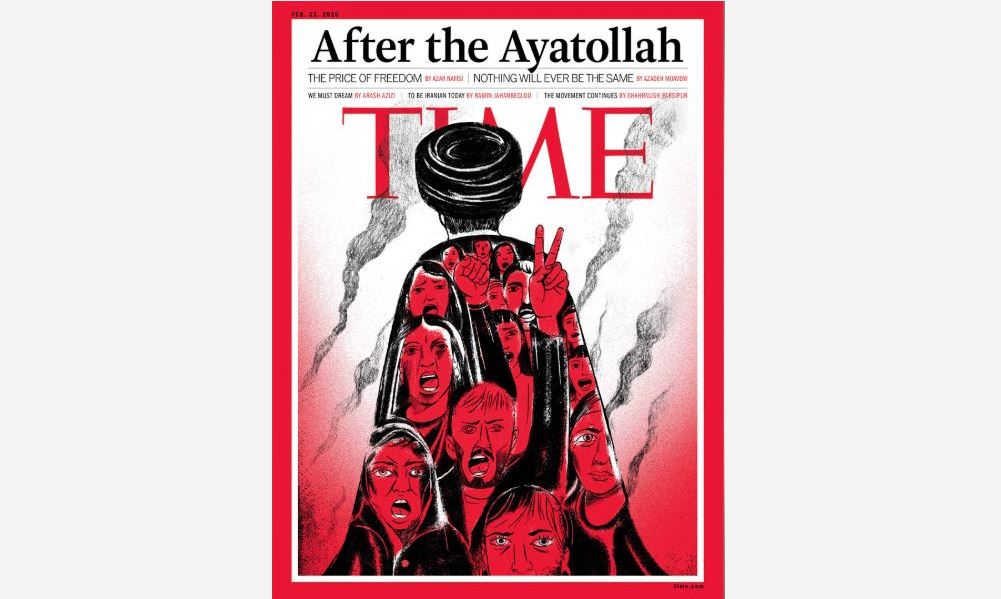
Time magazine has sparked a wide controversy after the release of its new cover titled “After the Ayatollah”, in a direct reference to the possibility of Iran entering a different political stage from the religious system established since the 1979 revolution.
The choice of title was not a passing description, but a heavy political message; it suggests that the era of absolute religious leadership may be nearing its end, whether through a transfer of power, changes within the structure of governance, or accumulated internal and external pressures pushing for a complete reshaping of the scene. The magazine usually uses its covers as a forward-looking reading of the future rather than breaking news.
The cover comes at a sensitive time: suffocating economic pressures, repeated social protests, an internal power struggle within the political establishment, and escalating regional tensions, in parallel with the resumption of nuclear talks with Washington in Muscat. All this reinforces the narrative that Tehran stands at a crossroads, and that the “post-Supreme Leader” phase is no longer a theoretical question but an issue on the agenda in Western decision-making circles.
Politically, such covers are also read as a symbolic pressure tool. They do not just analyse reality, but contribute to shaping it, by sending signals to the elites, markets, and public opinion that the current system is not as stable as it appears. This is often why they cause sensitivity in the capitals concerned, especially when they address the legitimacy of authority or its future.
In short, the cover does not declare an official farewell to the Iranian regime, but it puts a big question mark over its future... as if the magazine is saying: Stability in Tehran is no longer guaranteed, and what comes after the “Ayatollah” has become a political possibility on the table.
&uuid=(email))