

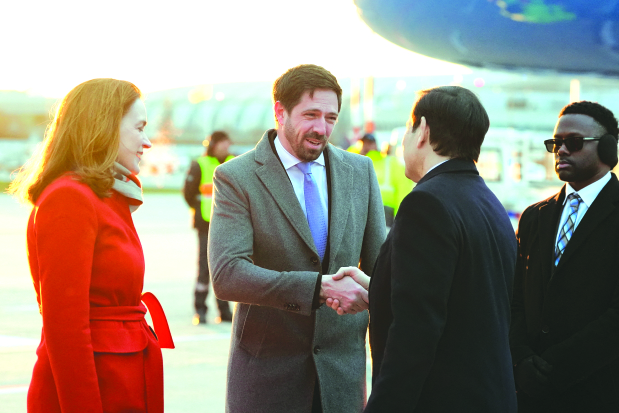
US Secretary of State Marco Rubio vowed to deepen co-operation with central Europe yesterday as he kicked off a trip to Slovakia and Hungary, whose conservative leaders have warm ties with President Donald Trump.
In Slovakia, which, like Hungary, relies on Russian oil and gas and has uneasy relations with the rest of the European Union, Rubio discussed energy and defence with Prime Minister Robert Fico and President Peter Pellegrini.
It was the first visit in seven years by a US secretary of state to the country of 5.5 million people that borders Ukraine.
“Under President Trump, this administration is going to make not just Slovakia but central Europe a key component of how we engage the continent and the world,” Rubio said.
“We are not just going to engage in meetings and pleasantries, but in concrete actions that we will take together in ways that are beneficial to your people and our people.”
On Saturday Rubio, who is also Trump’s national security adviser, delivered a message of unity at the Munich Security Conference while maintaining the administration’s criticism of Europe following a scarring year for Transatlantic ties.
Trump’s criticism of Europe, imposition of tariffs on EU countries and his ambition to acquire Greenland from fellow Nato Denmark have prompted Western European leaders to increasingly look at carving an independent path.
“We expect every country in the world to act in their national interest. That is what countries are supposed to do,” Rubio said.
“When our national interests are aligned ... this is an extraordinary opportunity for cooperation and partnership.”
Fico, who has said the European Union is in “deep crisis”, visited Trump last month in Florida and showered the Republican president with praise, saying he would bring peace.
Both Fico and Hungarian Prime Minister Viktor Orban, whom Rubio will meet today in the second leg of his trip, have been accused by EU institutions of weakening the judiciary, media and anti-corruption enforcement.
They have also maintained ties with Moscow, criticised and at times delayed the imposition of EU sanctions on Russia and opposed sending military aid to Ukraine.
&uuid=(email))