

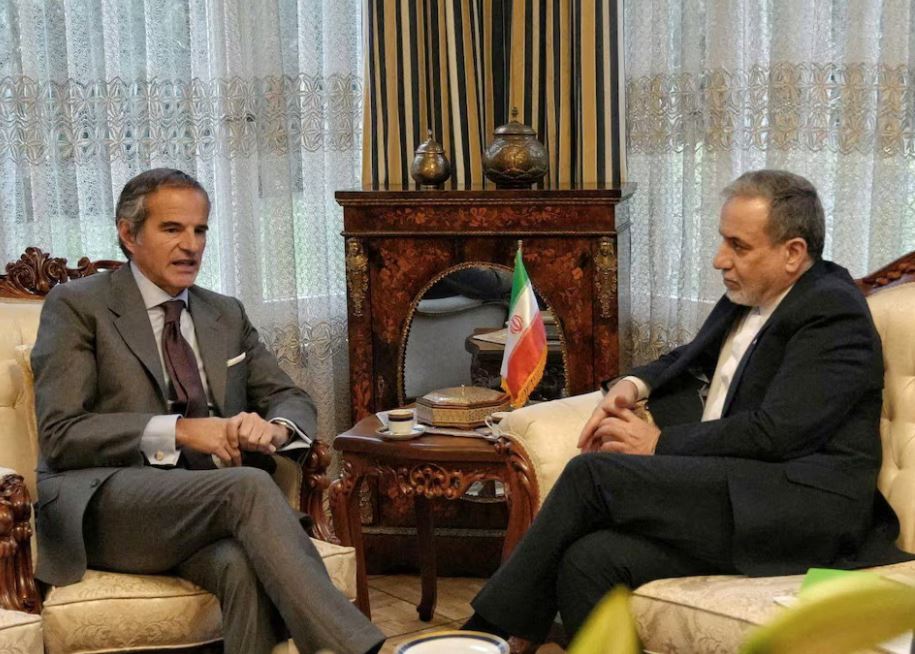
Iran’s foreign minister met the UN nuclear watchdog chief yesterday, ahead of talks between Washington and Tehran aimed at resolving a nuclear dispute, with few clear signs of compromise from either side and the threat of US military action looming.
Washington, which joined Israel in a wave of air strikes on Iran in June, has ordered a second aircraft carrier group to the Middle East in the latest standoff with Tehran, in addition to other US warships and aircraft that have already been deployed.
Adding to the tension, Iran began a military drill in the Strait of Hormuz, a vital international waterway and oil export route from Gulf states, who have been appealing for diplomacy to end the dispute.
The US and Iran renewed negotiations earlier this month hoping to tackle their decades-long dispute over Tehran’s nuclear programme, which Washington, other Western states and Israel all believe is aimed at building nuclear arms. Tehran denies this.
Oil prices were little changed yesterday, with investors weighing the market implications of upcoming US-Iran talks aimed at de-escalating frictions against a backdrop of expected Opec+ supply increases
However, Washington has sought to expand the scope of talks to non-nuclear issues such as Iran’s missile stockpile. Tehran says it is only willing to discuss curbs on its nuclear programme in exchange for sanctions relief and won’t accept zero uranium enrichment. It says its missile capabilities are off the table.
Speaking during a visit to Hungary, US Secretary of State Marco Rubio said reaching a deal with Tehran would be hard.
“I think that there’s an opportunity here to diplomatically reach an agreement that addresses the things we’re concerned about. We’ll be very open and welcoming to that. But I don’t want to overstate it either. It’s going to be hard. It’s been very difficult for anyone to do real deals with Iran, because we’re dealing with radical clerics who are making theological decisions, not geopolitical ones.”
Iran’s Foreign Minister Abbas Araqchi said he was in Geneva to ‘achieve a fair and equitable deal’.
“What is not on the table: submission before threats,” Araqchi said on X.
Iran has repeatedly threatened to close the Strait of Hormuz in retaliation against any attack, which would choke a fifth of global oil flows and send crude prices sharply higher.
Iran’s Revolutionary Guards have conducted a drill named ‘Smart Control of the Strait of Hormuz’, to test the readiness of the guards’ naval units to protect the waterway, the semi-official Tasnim news agency said.
“Intelligently utilising the geopolitical advantages of the Islamic republic in the Gulf and the Sea of Oman are among the main objectives of this exercise,” Tasnim said.
Iran’s Foreign Ministry said Araqchi had discussed co-operation with the International Atomic Energy Agency, as well as Tehran’s technical point of view regarding nuclear talks with the US during his meeting with IAEA head Rafael Grossi.
&uuid=(email))