

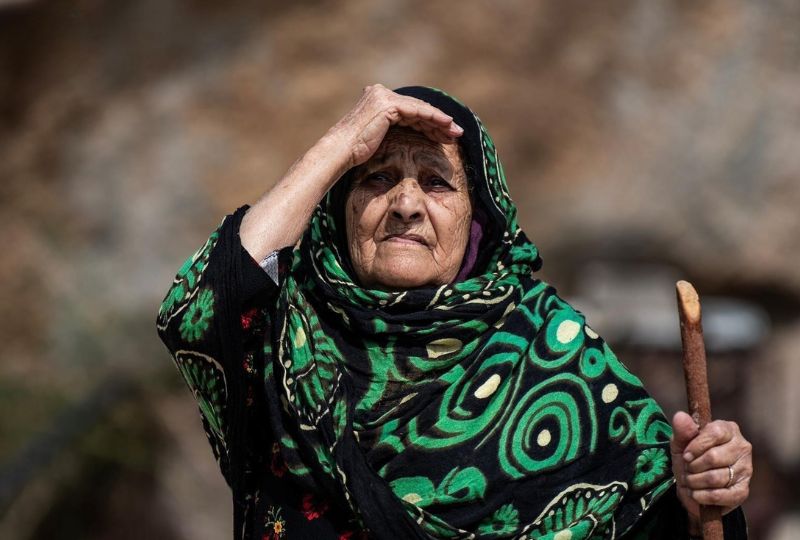
The memories of elderly residents in the mountainous villages of Maysan Governorate preserve vivid scenes and joyful social recollections spanning decades of observing the crescent moon marking the beginning of the holy month of Ramadan. At the time, naked-eye sighting was the sole means of announcing the start of the holy month, in a spiritual and social scene that predated modern technology, advanced observation tools, and the arrival of news in an official and unified manner.
Sharifah bint Atiyah Al-Thaqafi, nearly a century old and living in her village of Lykah -- affiliated with the Thaqif Center in Maysan Governorate -- recalled her memories of crescent sighting more than nine decades ago, noting that those nights represented a highly anticipated event for everyone, encapsulating feelings of anticipation, joy, and devotion, as the glad tidings of Ramadan were passed from one mountain peak to another.
During a visit by the Saudi Press Agency to her home nestled among massive rock formations in the mountains, Al-Thaqafi noted that preparations for anticipating the crescent would begin near sunset. Men, accompanied by their children, would head to nearby high elevations, such as the peaks of the Shahdan Mountains, to observe the crescent, while women remained at home awaiting news of the sighting amid an atmosphere of stillness filled with supplications, while busy preparing meals for iftar and suhoor.
She added that the announcement of the crescent sighting was met with widespread joy throughout the village community, expressed through exchanged congratulations, lighting piles of firewood atop mountain summits, and raising loud chants of takbir accompanied by expressions of happiness and poetic verses to convey the news to neighbouring villages.
These traditions embody the social fabric and spirit of cohesion and cooperation, with memories of announcing the advent of Ramadan extending to family gatherings during Ramadan nights and shared suhoor and iftar meals.
For his part, Majardah Thaqif Astronomical Observatory spokesperson Madis Al-Thaqafi noted that methods of anticipating the Ramadan crescent have undergone a notable transformation in recent times, shifting from reliance solely on direct visual observation to the use of advanced monitoring tools such as astronomical telescopes, digital imaging, and specialised computational applications. These tools enhance reliability and enable more precise scientific tracking of the crescent’s formation.
He pointed out that the stories and experiences preserved in the memories of the elderly remain a living human record documenting a historical phase in which religious observance was intertwined with daily life, as crescent sighting became a unifying event passed down through generations as an authentic element of place and collective identity in welcoming the holy month.
&uuid=(email))