

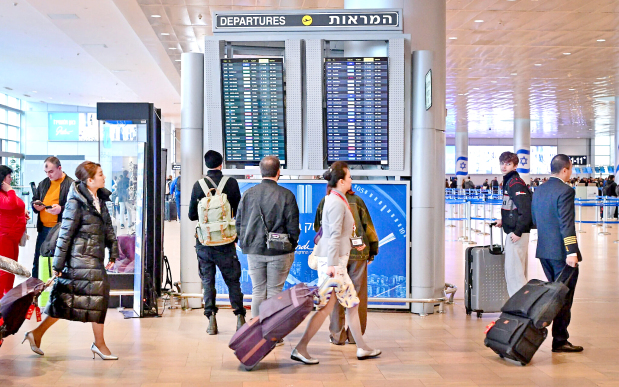
Britain, France, Germany and Poland yesterday warned against non-vital travel to Israel and the West Bank, joining multiple countries, including the US and China, that have issued warnings against travel to the region amid soaring tensions with Iran.
The UK Foreign Office said it has temporarily withdrawn embassy staff from Iran, and that the embassy there would keep working remotely.
The Foreign Office also said it has moved diplomatic staff in Israel and their dependents from Tel Aviv to another unnamed location in the country. The embassy in Israel was operating as normal but the situation “could escalate quickly and poses significant risks,” said the Foreign Office.
“We have taken the precautionary measure to temporarily move some of our staff and their dependents from Tel Aviv to another location within Israel,” the Foreign Office said in an update to its travel advice for Israel, which also called on UK citizens to avoid “all but essential” travel there.
France’s foreign ministry also reiterated its advice to nationals to refrain from traveling to Israel and the West Bank, and recommended that French citizens already there show vigilance, identify shelters and stay away from public gatherings.
And Germany’s foreign ministry, which has already warned nationals against travel to Iran, said in an advisory on its website yesterday that “travel to Israel and East Jerusalem is urgently discouraged.”
Poland’s foreign ministry called on citizens to immediately leave Israel, Iran and Lebanon.
“The security situation in the Middle East is unstable. The risk of escalation is high! Airspace for civilian traffic may be closed. Return by air may be impossible or significantly hindered,” it said in three X posts about the Middle Eastern countries.
Meanwhile, Italy’s foreign ministry urged citizens to leave Iran and advised extreme caution across the Middle East, citing persistently unstable security conditions.
“Italians in (Iran) for tourism or whose presence is not strictly necessary are urged to depart,” the ministry said in a statement, adding that travel to Iraq and Lebanon – both of which are home to powerful Iranian proxy groups – is also strongly discouraged. It also advised Italian nationals in Israel to exercise maximum caution and remain vigilant.
China also told its citizens to evacuate from Iran “as soon as possible,” and those in Israel to strengthen preparedness, citing a significant rise in security risks in the Middle East.
“Chinese nationals currently in Iran are advised to strengthen safety precautions and evacuate as soon as possible,” the foreign ministry said in a social media statement.
Flights from Istanbul airport to Tehran were cancelled yesterday night amid a mounting US military buildup around Iran.
Istanbul airport said flights by Turkish Airlines and two Iranian companies to the Iranian capital had been cancelled.
Four flights to Tehran scheduled for today have also been cancelled, though six others remain on the schedule. A Turkish Airlines flight to the northern Iranian city of Tabriz, due to leave earlier today, has also been called off.
Turkish authorities made no comment on events in Iran yesterday, declining to join the litany of nations advising their citizens against travel to the Islamic republic.
Türkiye has a 550km frontier with Iran that has three crossing points.
The warnings came as US Ambassador to Israel Mike Huckabee yesterday told embassy staff who wished to leave the country to do so ‘TODAY’, a day after the third round of indirect US-Iran nuclear talks, which US President Donald Trump described as unsatisfactory.
Trump has repeatedly threatened to attack the Islamic Republic, first over its bloody crackdown on anti-regime protesters last month and more recently over its refusal to halt its nuclear programme.
He has ordered a large military buildup in the region, with US fighter jets deploying at an Israeli air base and USS Gerald R Ford, the world’s largest aircraft carrier, set to arrive off Israel’s northern coast, near the port city of Haifa.
Israel is preparing for the possibility that it will be targeted in a retaliatory Iranian strike and find itself fighting alongside the US.
During the 12-day Israel-Iran war in June, the Islamic Republic launched over 500 ballistic missiles and around 1,100 drones at Israel, killing 32 people and wounding over 3,000, according to health officials and hospitals.
In all, there were 36 missile impacts and one drone strike in populated areas, causing damage to 2,305 homes in 240 buildings.
&uuid=(email))