

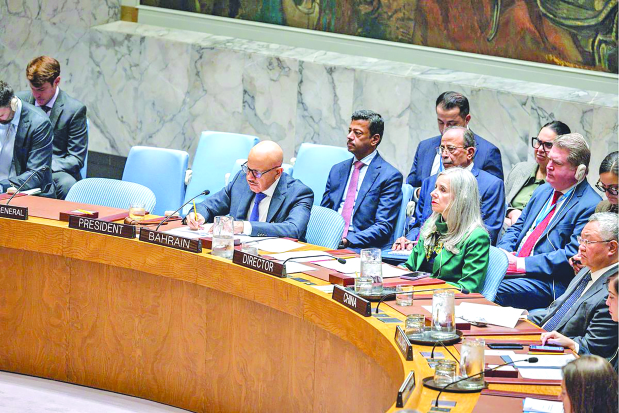
As part of Bahrain’s presidency of the United Nations Security Council for April, Foreign Minister Dr Abdullatif Al Zayani chaired the high-level Security Council session on co-operation between the Gulf Cooperation Council (GCC) and the United Nations.
The session, held at the UN headquarters in New York, was under the agenda item: “Cooperation between the United Nations and regional and subregional organisations in maintaining international peace and security.”
Participating in the session were Khaled Khiari, assistant secretary-general for the Middle East, Europe, the Americas, Asia, and the Pacific; and GCC secretary-general Jasem Mohamed Albudaiwi.
In his remarks, the Foreign Minister conveyed the greetings of His Majesty King Hamad and His Royal Highness Prince Salman bin Hamad Al Khalifa, Crown Prince and Prime Minister, together with their deep appreciation for the constructive role played by the Security Council and its continued efforts in the maintenance of international peace and security.
He also expressed Bahrain’s profound pride in its non-permanent membership of the Security Council for the 2026-2027 term, and in its presidency of the council during this month.
He extended to the members of the Council sincere thanks and appreciation for the adoption of Security Council resolution 2817, tabled by Bahrain on behalf of the GCC member states and Jordan, concerning Iran’s unlawful ballistic missile and drone attacks, which were deliberately and meticulously planned with extreme precision, and which lay bare Iran’s aggressive intent towards its peaceful neighbouring states.
Those attacks targeted infrastructure, critical facilities, and civilian sites, including airports, ports, hotels, energy facilities, factories, universities, food supply infrastructure, essential service facilities, residential areas, desalination plants, and diplomatic premises, causing significant loss of life and property.
He said that the efficiency and readiness of the armed forces and air defence systems of the GCC States and Jordan enabled them to confront those ballistic missiles and drones with courage, competence, and professionalism. Their response helped to neutralise the threat, mitigate its effects, and protect lives, facilities, and vital national assets.
He also appreciated the Security Council’s firm commitment to the sovereignty, independence, unity, and territorial integrity of the GCC states, as well as for the unprecedented support garnered by Security Council resolution 2817 from 136 United Nations member states. This underscores the international community’s strong rejection of those Iranian attacks, which are contrary to international law, the Charter of the United Nations, and the principles of good neighbourliness.
He said the kingdom highly valued the adoption by the Human Rights Council in Geneva of resolution L.38, submitted by Bahrain, on the human rights implications of those treacherous Iranian attacks targeting the GCC states and Jordan, during the urgent debate convened as part of the Council’s 61st session on March 25.
The resolution received unprecedented support from 115 sponsoring member states, reflecting the will and commitment of the international community to the protection of human rights, including through the resolution’s explicit condemnation, in the strongest terms, of the attacks launched by Iran as a grave violation of international law, including international human rights law and international humanitarian law.
This important human rights position at the international level confirms the international community’s categorical rejection of those Iranian transgressions and grave violations, which display contempt for international law, international instruments, and Security Council resolutions, and which are devoid of religious, moral and humanitarian values, he said.
“It is both regrettable and deeply distressing that Iran did not confine itself to its treacherous attacks against the GCC states and Jordan and their civilian infrastructure, to the shedding of innocent blood, and to the terrorising of peaceful citizens and residents. Rather, it went further by threatening the global economy through the closure of the Strait of Hormuz and by seeking to control international navigation in the strait, thereby endangering energy security, food supplies and global trade, in flagrant violation of international law and the United Nations Convention on the Law of the Sea.
“In this regard, we commend the Council for affirming, in Security Council resolution 2817, the importance of maritime security and freedom of navigation in the Strait of Hormuz, and that any disruption to vital waterways may have implications for international trade and global economic stability,” he said.
In light of all this, Bahrain submitted to the Council a draft resolution concerning Iran’s unlawful attempt to assert control over international navigation in the Strait of Hormuz.
This has placed a serious test before the Council, requiring a firm position in the face of such unlawful and irresponsible conduct, which threatens the interests of nations and peoples across the world.
Dr Al Zayani expressed confidence that the draft resolution was consistent with international law and with the provisions of the United Nations Convention on the Law of the Sea, under which the right of ships to transit passage through straits may not be impeded, as Iran is seeking to do today.
He was hopeful of a unified position from the Council during today’s vote on this draft resolution.
In Bahrain’s capacity as president of the current session of the GCC, he thanked the Council for convening the meeting to discuss co-operation between the United Nations and the GCC, whose member states have consistently affirmed their full commitment to the purposes and principles of the Charter of the United Nations.
They have long believed that an effective partnership with the United Nations can strengthen the vital role of regional organisations in addressing global challenges and conflicts, in accordance with Chapter VIII of the Charter of the United Nations, he said.
Since its establishment 45 years ago, the GCC has demonstrated that it is an active and effective regional organisation, fully engaged with regional and international issues and contributing to the advancement of regional peace and security.
Consistent with Chapter VIII of the Charter of the United Nations, which underscores the importance of the role of regional organisations in the settlement of disputes and in contributing to the maintenance of international peace and security, the GCC played a prominent role in resolving the Yemeni crisis in 2011 through the Gulf Initiative and its Implementation Mechanism, which helped spare bloodshed and address the crisis peacefully, and which remains to this day one of the principal international reference points for resolving the Yemeni crisis.
The GCC has also played an effective role in easing regional tensions and supporting efforts aimed at resolving crises in a number of countries in the region, including Syria, Palestine, Lebanon, Libya, and Gaza, and it will continue to pursue this role in co-operation and partnership with the United Nations and peace-loving states.
At the conclusion of the session, the Council adopted a presidential statement recognising the GCC’s standing and expertise in advancing sustainable regional peace and security.
It commended the Council’s contributions to regional and international stability through mediation, preventive diplomacy, technical and financial support, and humanitarian engagement across all stages of peacebuilding.
The statement welcomed ongoing consultations between the UN and GCC secretariats and underscored the importance of strengthening institutional co-operation through regular dialogue, co-ordination mechanisms, and information-sharing in areas including conflict prevention, mediation, peacebuilding, counterterrorism, and humanitarian response.
It also recalled relevant Security Council resolutions highlighting the Gulf region’s importance to international peace and security, its vital role in global economic stability, and the significant contributions of GCC member states to UN peacekeeping and humanitarian efforts.
&uuid=(email))