

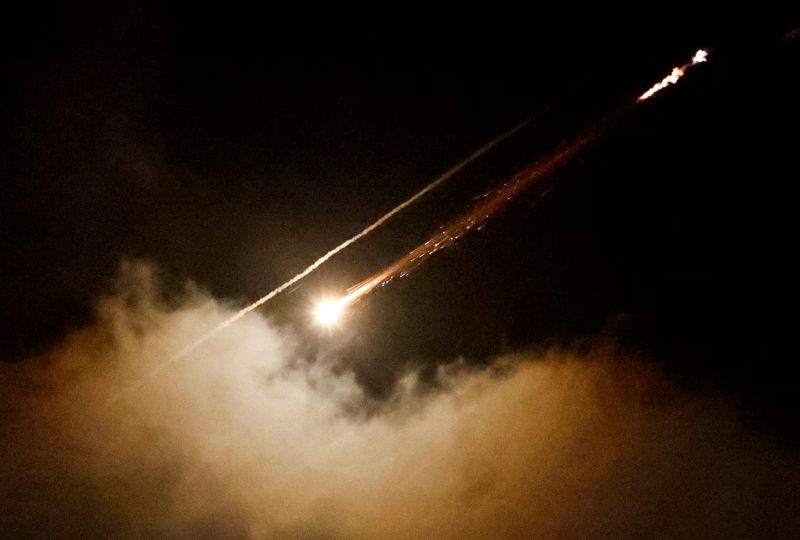
The United States began a fresh round of strikes against multiple targets in Iran early this morning, the US military said, hours after President Donald Trump vowed new attacks if no peace deal is secured.
“The strikes are in response to Iran’s unwarranted and continued aggression,” the military’s Central Command said in a post on X, adding that the strikes began at 5.15pm ET (12.15am Bahrain time).
The attacks are the latest development in an escalating exchange of strikes that threaten to reignite a full-scale war, which was paused in early April when the two sides agreed to a fragile ceasefire.
An explosion was heard in the port city of Sirik, and air defences were activated in west Tehran, Iran’s Mehr news agency reported.
Trump told reporters earlier at the White House, “We’re going to be attacking them, attacking them very hard.”
US Defence Secretary Pete Hegseth later told reporters during a visit to Central Command in Florida that the strikes would ‘advance our military interests and also enhance our diplomatic position’.
“We will strike them hard tonight, and hopefully Iran makes a good decision,” he said. “If we need to negotiate with bombs, we’ll negotiate with bombs.”
The United States and Iran have traded fire several times since the tentative ceasefire took hold, even as negotiators have unsuccessfully sought an end to the three-month-old war.
Trump has repeatedly said a deal is close, though there has been no sign of a breakthrough, while also threatening to resume bombing.
The US military targeted air defences and radar sites around the Strait of Hormuz yesterday after a US attack helicopter was downed near the strategic waterway on Monday. Iran responded with missile and drone attacks on US bases in Jordan, Kuwait and Bahrain. A US official said there was no significant damage.
Iran accused the US of striking reservoirs that supplied drinking water to 10 villages and violating international law.
“This is not collateral damage – it is a calculated war crime and a flagrant violation of human rights,” Foreign Ministry spokesperson Esmaeil Baghei said.
The Pentagon did not immediately respond to a request for comment.
Trump, who has threatened before to destroy Iran’s civilian infrastructure, did
not say whether the coming strikes would target power plants and bridges.
not say whether the coming strikes would target power plants and bridges.
The head of the Iranian parliament’s national security committee, Ebrahim Azizi, warned in response that the “war won’t be limited to the region.”
Despite the belligerent language from both sides, there were signs of continuing diplomatic efforts.
A delegation from Qatar, which has been mediating between the United States and Iran, landed in Tehran yesterday to hold talks on the latest developments, Iranian media reported.
The war has killed thousands and disrupted roughly one-fifth of the world’s supply of oil and natural gas, sending prices sharply higher. Iran has blocked traffic through the Strait of Hormuz, while the US has maintained its own blockade on Iranian ports.
Oil prices rose nearly $3 following Trump’s threat of escalation, to $94 per barrel. Trump said vessels carrying 100 million barrels of oil have defied Iran to travel through the strait as part of a secret military mission. He said oil prices would be much higher without the effort.
Hegseth said ships have been transiting the strait “in the middle of the night,
protected by the United States in a way that Iran can’t stop, they can’t see it.”
protected by the United States in a way that Iran can’t stop, they can’t see it.”
Separately, the US military said it disabled an oil tanker transporting Iranian crude in the Gulf of Oman on Tuesday for a second consecutive day.
Three Indian seafarers are still missing after 21 other Indian mariners were rescued following an attack on their tanker off the coast of Oman, India’s foreign ministry said.
“We condemn the attack on the commercial vessel Settebello off the coast of Oman, earlier today,” the ministry said in a statement yesterday.
Maritime officials said the oil products tanker had been hit in a suspected US missile strike.
Trump says Iran must end its restrictions on shipping through Hormuz. He also says any peace deal must ensure Iran cannot develop a nuclear weapon.
Iran denies any such ambition. The UN nuclear watchdog’s 35-nation Board of Governors passed a US-backed resolution telling Iran to declare its remaining enriched uranium stocks and let inspectors verify them. Iran branded the resolution as ‘political’.
The Trump administration plans to meet executives from the biggest US defence contractors at the White House as soon as next week to discuss accelerating production, as US strikes on Iran and other military operations draw down supplies, sources said.
The meeting would mark the second White House gathering with chief executives of major defence firms on ramping up weapons production. A March meeting included the CEOs and other officials from BAE Systems, Lockheed Martin, Northrop Grumman, RTX Corporation, Boeing, Honeywell Aerospace and L3Harris Technologies, along with Defence Secretary Pete Hegseth. The war with Iran, as well as supplies sent to Ukraine in recent years, have depleted US weapons stockpiles.
White House spokeswoman Anna Kelly said, “The United States military has more than enough munitions, ammo, and stockpiles to serve all of President Trump’s strategic goals and beyond, and Operation Epic Fury has exposed what happens when you mess with the United States.
Even still, the President has urged our defence contractors to constantly produce more made-in-America weapons, which are the best in the world.
Democrats destroyed our military, but President Trump rebuilt it.”
Democrats destroyed our military, but President Trump rebuilt it.”
The meeting comes as Pentagon negotiators press contractors to move much faster, with production agreements struck earlier this year at the centre of those efforts.
&uuid=(email))