

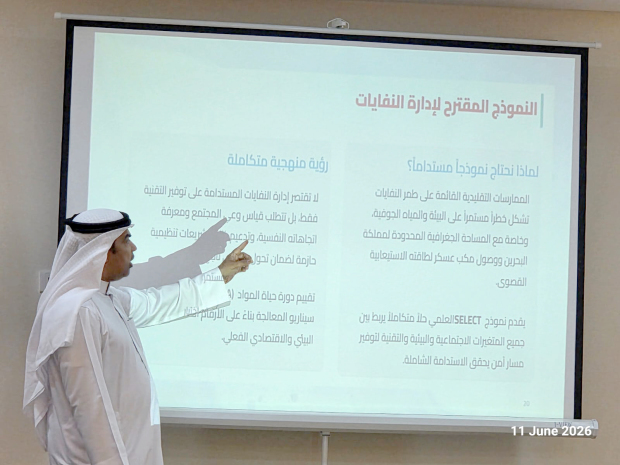
Composting, recycling and stronger public awareness are key to securing sustainable cities in Bahrain, experts have said.
The call came during a seminar hosted by the Northern Municipal Council yesterday to mark World Environment Day, where specialists highlighted the growing challenge of waste management and the urgent need for long-term solutions.
The lecture, titled ‘Sustainable Waste Management for Sustainable Cities’, was delivered by Northern Municipal Council follow-up and co-ordination head and environmental and sustainable development specialist Dr Mahmood Al Afia, who presented alarming global and regional statistics revealing the scale of the problem.
“Global waste generation is expected to rise from 2.1 billion tonnes in 2023 to 3.8bn tonnes by 2050,” Dr Al Afia said. “If current trends continue, the economic cost could exceed $640bn, while the environmental and social costs are even higher.”
Turning to Bahrain, Dr Al Afia said that the kingdom produces around 1,600 tonnes of household waste daily, including approximately 400 tonnes of food waste.
“Food waste alone is estimated to cost Bahrain more than BD95 million annually,” he said. “The challenge is not only environmental, but also economic and social.”
His research found that composting organic waste was the most sustainable solution for Bahrain.
“Composting came first, recycling second and sanitary landfills third,” he explained. “Traditional landfills remain the least sustainable option because of their impact on climate change and greenhouse gas emissions.”
Dr Al Afia noted that food waste surges dramatically during Ramadan and religious occasions, with daily waste volumes rising to approximately 600 tonnes per day, compared with an average of 400 tonnes daily throughout the rest of the year.
“The increase during Ramadan reflects consumption patterns that require greater public awareness and behavioural change,” he said. “Reducing food waste is one of the quickest and most effective ways to improve sustainability and reduce economic losses.”
Northern Municipal Council chairman Dr Sayed Shubbar Al Wedaie, who attended the seminar and led the discussion session afterwards, stressed the importance of turning research into practical policies.
“We need co-operation between municipalities, government agencies, the private sector and citizens,” he said. “Sustainability is not achieved through studies alone; it requires action, awareness and commitment from everyone.”
Dr Al Wedaie praised efforts to increase environmental awareness and said that municipal councils are keen to support initiatives that promote waste reduction, recycling and sustainable urban development.
Also participating in the discussion was Abdulhamid Al Saie, head of household waste regulation operations at Estadamah under the Municipalities Affairs and Agriculture Ministry.
Mr Al Saie highlighted the progress achieved in Bahrain’s waste sector.
“Construction waste is now being recycled and returned as raw materials for use in new projects,” he said.
He also revealed a dramatic turnaround in tyre waste management. “In the past we had around 750,000 discarded tyres, creating a serious environmental challenge. Today that stockpile has effectively been eliminated through recycling programmes.”
Mr Al Saie said Bahrain was continuing efforts to upgrade the kingdom’s main landfill site into a modern sanitary landfill while exploring new environmental technologies.
“Methane gas remains one of the biggest environmental concerns associated with landfill sites,” he said. “Extracting biogas is technically possible, but requires substantial investment. One practical option is capturing methane and burning it to reduce its harmful environmental impact.”
He added that co-operation among GCC countries would be essential in sharing expertise and developing advanced waste management solutions.
Among the recommendations presented were introducing household waste sorting systems, expanding recycling infrastructure, strengthening environmental legislation, encouraging private-sector investment and integrating waste management concepts into school curricula.
The seminar concluded with a call for Bahrain to move towards a circular economy where waste is viewed not as a burden, but as a valuable resource capable of generating jobs, protecting the environment and supporting sustainable cities for future generations.
mohammed@gdnmedia.bh
&uuid=(email))