

Analysis of the Austrian Grand Prix, brought to you by Bahrain International Circuit
F1 – With a two-week gap to the race weekend in Austria, teams had another chance to develop and deploy their latest upgrades on their 2026 cars.
Cadillac, who have had a generally positive introduction to their debut season in F1, bought the most fresh components to The Red Bull Ring with ten, with Red Bull and Audi upgrading seven parts each. Williams and Aston Martin were the only teams to bring the same cars as Barcelona with remaining teams carrying varying degrees of new elements.
Practice sessions showed that we were in for another close fought battle between Mercedes and Ferrari, with Ferrari bouncing with confidence after Hamilton’s victory last time out.
McLaren had shown strong race pace in practice sessions and were not far behind, with Max Verstappen in his Red Bull still managing to eke out performance in a car which is still finding its feet under the new regulations.
Remarkably, there was just 0.4 seconds splitting the top seven places in the final part of qualifying and it seemed it was heading the way of Ferrari as the session was concluding.
As the final laps were being completed, a rear wing failure caused Verstappen to crash, with yellow flags issued immediately. Under the regulations, drivers are obliged to ease off through the relevant sector.
Remarkably, George Russell had shown to ease off but still managed to set the fastest lap.
It was an unusual situation that led to much analysis and debate. Telemetry did show that Russell had eased off enough and had therefore complied with the rules.
His pole position stood, with Charles Leclerc and Lewis Hamilton just behind. Kimi Antonelli had to settle for fourth, followed by Verstappen and the two McLarens completing the top eight.
The combination of the unusually hot weather (by the race start the track temperature was over 60 degrees) and expected tyre degradation, a one stop race seemed out of the question, with a two stops strategy seen to be the most efficient.
However, depending on other external factors, especially the possibility of a safety car, three stops were not out of the question either.
It was a hectic start to the race. Russell got off well and there was a scrap between the pair of Ferraris, with Hamilton taking Leclerc.
Whilst that was going on, Verstappen took the chance to move into third just behind Hamilton.
The McLarens also had an early fight, with Oscar Piastri taking Lando Norris, whilst Antonelli somehow managed to keep fifth place, despite going off the track three times on the opening lap. Antonelli recovered and by lap eight overtook Leclerc going into turn nine.
Back towards the front, the battle between Hamilton in second and Verstappen behind was one for the ages, with two world champions going toe-to-toe.
That battle was ended as Hamilton became the first of the front-runners to pit on lap 13.
Leclerc followed the following lap, suggesting both cars were opting for a three-stop strategy, playing out in a similar way to Barcelona two weeks ago.
Verstappen then came in on lap 19, but still came out from the pits behind Hamilton.
Upfront, Russell reacted by coming in on lap 20, with McLaren sitting in sixth and seventh also pitting.
By the end of the first pit stops, Russell had kept the lead, followed by Verstappen who had made a move stick against Hamilton who was now third. Leclerc followed, then Antonelli, Hadjar and Norris.
Hamilton then went for an additional early second stop (he would make three in total) for a stint on soft tyres and managed to fight his way to sixth, whilst his teammate was struggling in fourth, allowing both Piastri and Hamilton to take advantage for an overtake. Leclerc was immediately in the pits for new tyres.
There were a further set of pit stops starting on lap 43 and by lap 51, the leaders had all completed their final stops.
Russell had maintained his position in first, as had Verstappen in second, with Antonelli third, then Piastri, Hamilton and Leclerc.
On lap 57, Hadjar managed an overtake on Leclerc, showing that the Red Bull race pace was improving with the upgrades, but also that both Ferraris were struggling with tyres.
This was compounded further as Norris took Leclerc just two laps later to take the world champion to seventh.
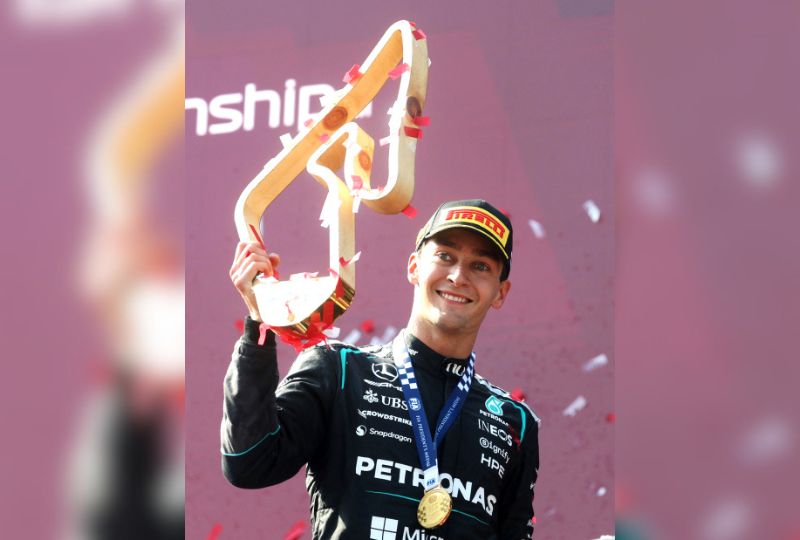
However, it was Russell upfront who maintained his dominance for a comfortable victory, despite Verstappen’s best efforts who took a commendable second.
Antonelli held out for third, with Piastri, Hamilton, Hadjar and Norris retaining their places in the closing stages.
After Leclerc struggled into eighth, the two Racing Bulls of Lawson and Lindblad completed the top ten.
It was another strong result for Mercedes, but with Ferrari maintaining their competitive spirit at the front, a fast-improving Red Bull, and McLaren showing some strong race pace, the battle for the championship looks set to heat up further in the European summer sunshine.
F1 is straight back to action next weekend, for one of the racing highlights of the season at Silverstone.
* Laurence Jones is senior manager, Marketing and Communications, Bahrain International Circuit
l.jones@bic.com.bh
&uuid=(email))