

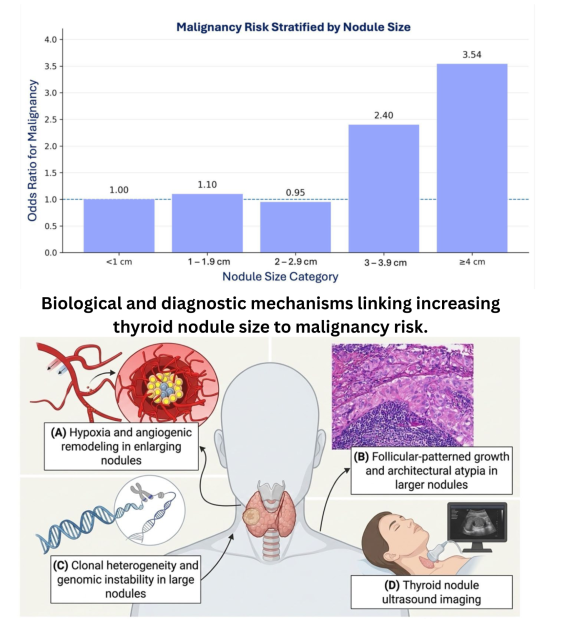
A new study covering more than 400 patients in Bahrain has identified the relationship between the thyroid nodule size and the likelihood of cancer.
The study, entitled ‘Thyroid Nodule Size as a Predictor of Malignancy in Bahrain: A Retrospective Cohort Study’, was conducted by the Royal College of Surgeons in Ireland (RCSI) – Medical University of Bahrain, in collaboration with King Hamad University Hospital.
The new research published in the international peer-reviewed journal Diagnostics could help strengthen the assessment and management of thyroid nodules in Bahrain and further highlight the importance of locally generated evidence to support more informed clinical decision-making and improve patient care.
Thyroid nodules are lumps that develop within the thyroid gland and are a common finding, particularly as people get older.
While the vast majority are benign, determining which nodules may be cancerous remains a significant clinical challenge, making accurate diagnosis essential to ensure patients receive the most appropriate treatment.
This study is believed to be the first in Bahrain to analyse clinical data from 446 adult patients to investigate the relationship between thyroid nodule size and the likelihood of thyroid cancer. They were evaluated between 2018 and 2025 at a specialised medical facility for thyroid-stimulating hormone (TSH), free thyroxine (free T4), and sonographic characteristics among other tests.
The findings suggest that larger nodules may warrant closer evaluation and consideration for biopsy or specialist referral, even when ultrasound features suggest a lower risk.
The study also identified a higher rate of malignancy among older patients, underscoring the importance of careful assessment in this group.
“The study found that patients with nodules larger than 3cm had almost three times the odds of malignancy, while nodules exceeding 4cm had more than three-and-a-half times the odds of being cancerous,” it stated.
“The findings also suggest that patterns of thyroid cancer risk reported in international studies may not always reflect those seen in Bahrain, highlighting the importance of generating evidence within the local population to support clinical decision-making and improve patient care.”
The research was led by RCSI Medical University of Bahrain’s Pathology Professor Alexandra Butler, Class of 2012 graduate and Consultant Endocrinologist at King Hamad University Hospital Dr Jenan Obaid, alongside a multidisciplinary team of researchers and six medical students.
The experts found that nodule size was the strongest independent predictor of malignancy, even after accounting for ultrasound characteristics and other clinical factors.
“Thyroid nodules are commonly encountered in clinical practice, yet determining which are malignant remains a significant challenge,” added Prof Butler.
“This collaborative study demonstrates that nodule size is a particularly important predictor of cancer risk in the Bahraini population, emerging as the strongest independent predictor of malignancy even when ultrasound findings and other clinical factors were considered.
“By generating evidence that reflects the needs of our population, we can support more informed clinical decision-making and ultimately improve patient care.”
The thyroid is a small, butterfly-shaped gland located at the base of the neck. It’s a part of the endocrine system and controls many of the body’s important functions by producing and releasing hormones.
An underactive thyroid, which doesn’t produce the right amount of hormones results in hypothyroidism, and this condition can lead to a patient experiencing weight gain and a slowed-down heart rate.
Hyperthyroidism happens when the gland makes more than the required amount of hormones, which can also cause a series of problems including weight loss and irregular heartbeat.
In Bahrain, Vitamin D deficiency is common and the lack or insufficient level of Vitamin D, which is required for the normal functioning of the thyroid gland, could lead to thyroid issues.
&uuid=(email))