

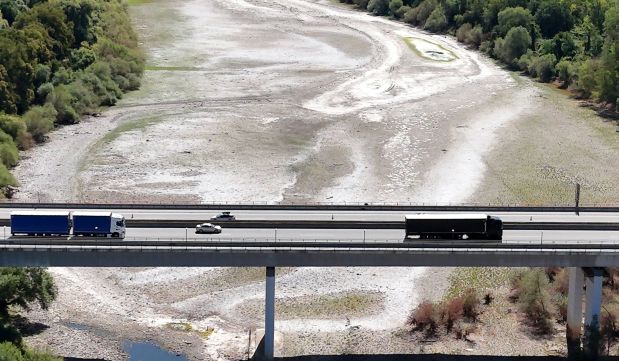
Water levels on the Rhine river fell to record lows overnight as a heatwave across Europe continued, data from Germany’s inland navigation agency WSV showed yesterday, meaning most transport was shifted to trucks and trains.
WSV data showed the water level gauge at the chokepoint of Kaub near Koblenz fell to 6 centimetres (2.4 inches) late on Friday and was 8cm early yesterday.
WSV data had shown 10cm for Kaub early on Friday, which was also below the previous record level of 25cm recorded in 2018.
The river is about 1 metre deeper than the gauge, which has been traditionally used as an indicator to measure local levels.
Kaub levels were last above the 78cm level in mid-July.
As a rule of thumb, if the water level gauge at Kaub falls below 78cm for 30 straight days, as was the case in 2022 and 2018, industrial production falls by 1 per cent, according to the Kiel Institute for the World Economy.
The Rhine is one of Europe’s most important transport arteries, needed to ship chemicals, commodities, fuel and other goods.
German companies have started to report disruption from low Rhine water levels.
Chemical producers, utilities, steelmakers and agricultural traders have warned of higher costs, transport bottlenecks and reduced production.
“Additional rail services are being operated, extra trucking capacity is being deployed, and terminals on the Lower Rhine are increasingly being used as logistics hubs,” container logistics and river shipping group Contargo said. “We are fighting for every container and doing everything possible to keep our customers’ supply chains moving. When one mode of transport reaches its limits, we shift capacity to other modes and combine inland shipping, rail and road transport.”
It added: “Our captains decide from day to day whether, and on which sections of the Rhine, it is still possible and practical to operate their vessels.”
&uuid=(email))