

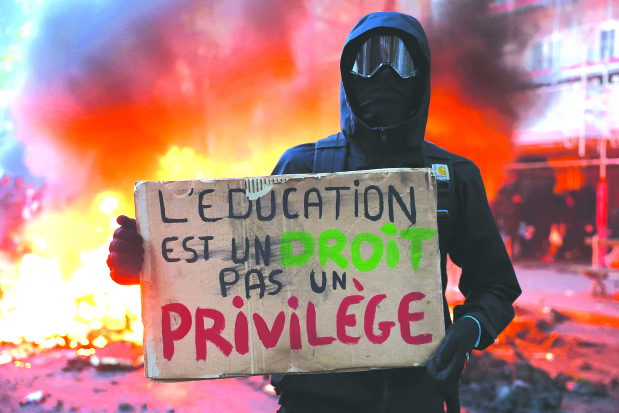
Clashes broke out between police and protesters in cities across France yesterday as tens of thousands of people took to the streets in some of the country’s most violent protests in years over rising costs and declining public services.
Some 272 people had been arrested by mid-afternoon after violent incidents involving hooded individuals, including in Paris, Marseille in the south, Rennes in the northwest, Toulouse in the southwest and Angers in the west, the Interior Ministry said.
“Such actions include attempted looting, confrontations with law enforcement, the setting of fires to street furniture and the targeting of seats of power and media outlets,” it said, blaming the unrest on what it described as the ‘ultra-left’.
Belgium, Portugal and Italy also faced smaller-scale protests as living costs rise in Europe, while protesters in Albania again rallied against perceived government corruption, a lack of jobs and poor education standards.
In Lyon, in east-central France, protesters also set ablaze a tourist office.
The protests began last month at high schools in Paris’ poor northern suburbs, where anger over teacher shortages and shabby facilities evolved into a broader movement focused on inequality, public spending and living standards.
“We are fighting because the cost of living is too harsh, because the price of fuel is too high, because high school pupils are being violently attacked and hurt all over the country just for trying to protest and ask for more teachers and decent learning conditions,” said Lola, a 19-year-old protester in Paris.
A large police presence was visible in central Paris, especially near landmarks such as the Champs-Elysees and the Arc de Triomphe, which were excluded from the routes of two authorised demonstrations.
Protesters in high-visibility vests blocked streets, recalling the Yellow Vest movement that marked President Emmanuel Macron’s previous term in office.
In Marseille, the mayor said the town hall had been vandalised and that additional police were being sent to the city following talks with the prime minister and interior minister.
Macron, who urged calm on Friday, is entering the final stretch of his presidency amid a fragmented political landscape and growing pressure over the economy.
France’s efforts to reduce public debt have failed to reassure investors, pushing government borrowing costs to their highest levels in more than two decades.
Police tactics have drawn criticism following a series of injuries among demonstrators, including a teenager who lost a hand after picking up a stun grenade.
Prime Minister Sebastien Lecornu said more than 900 police officers had also been injured in previous protests.
The police watchdog is investigating at least two dozen allegations of police violence.
France suspended the use of stun grenades during the student demonstrations, but Interior Minister Laurent Nunez said they could be used later.
Calls on social media for veterans of previous protest movements to join the demonstrations appeared to have broadened participation.
The Yellow Vest movement emerged in 2018 in opposition to diesel taxes before expanding into a wider protest against living costs and inequality.
The movement subsided after Macron announced billions of euros in tax cuts.
Yannick Maillou, a teacher from La Crèche in western France who participated in the Yellow Vest movement, said several gathering points had been organised locally for the protests, with labour unions also encouraging participation.
Police in Albania fired what appeared to be rubber bullets at protesters yesterday, the fifth day of mass student demonstrations demanding Prime Minister Edi Rama step down.
The incident marks an escalation in a confrontation between police and protesters that has engulfed central Tirana in recent days.
Demonstrators have burned government buildings and banks and hurled rocks at police, who have responded with tear gas and water cannon.
Tens of thousands of people marched through central Lisbon to protest against soaring living costs and a deepening housing crisis in Portugal, increasing pressure on the centre-right government.
Portugal’s biggest union, CGTP, which called the rally, said ‘many tens of thousands’ packed one of the capital’s main avenues. Police gave no crowd estimate.
Italian police fired tear gas after coming under attack from protesters throwing stones and other objects in clashes in the square in front of Milan’s Gothic cathedral, Italian media reported. Police in riot gear also tried to clear hooded protesters from the Galleria Vittorio Emanuele II, the luxury shopping arcade which is on one side of the cathedral.
&uuid=(email))