

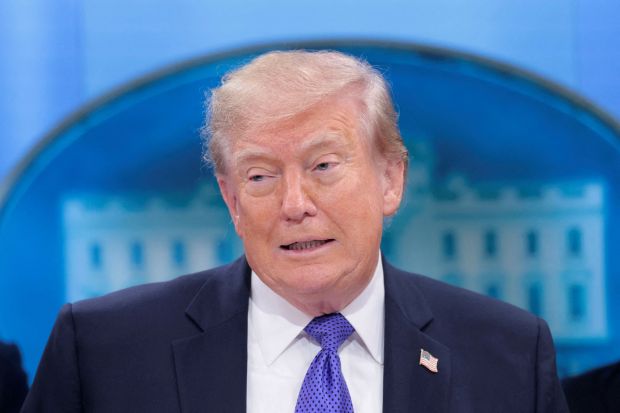
US President Donald Trump yesterday fired a new tariff salvo on 14 major trading partners including China, Japan and the European Union, undeterred in his protectionist push by the losses his Republican Party suffered in US midterm elections.
His administration proposed new headline tariff rates of 20 per cent to 40pc, but said duties would be capped at lower levels agreed under trade deals that have already been concluded or remain under negotiation.
Separately, the United States Trade Representative proposed a new 10pc tariff on imports of Brazil’s finished Embraer commercial aircraft, and to raise duties on imports of Brazilian sugar that exceed quotas as part of an effort to push Brasilia to rectify alleged unfair trade practices.
The products were previously exempted from Trump’s 25pc tariffs on Brazilian goods that were imposed in July. A US official said that despite negotiations, there were ‘substantial differences’ over the allegations.
Under the main ‘Section 301’ probe into excess industrial capacity, China would face the highest capped rate of 20pc, which would be added to duties of roughly 25pc imposed during Trump’s first term.
That rate would comply with a US-China trade truce that expires on January 10. But if the truce unravels, China’s rate would rise to 40pc, the USTR said.
Vietnam would face a capped tariff rate of 20pc if it reaches a trade agreement with Washington, rising to 35pc if negotiations fail.
US Trade Representative Jamieson Greer said the tariffs, which would not take effect until after a January 25 public hearing, were intended to counteract ‘industrial strategies built on targeting manufacturing, wage and labour suppression, financial and other support, non-market economy inputs, and other market-distorting practices’ that undermine the US manufacturing base.
Beijing earlier reiterated its opposition to ‘trade wars’ and rejected allegations of overcapacity, but stopped short of threatening retaliation.
The USTR also proposed capped tariff rates of 18pc for imported goods from Cambodia, Indonesia, Malaysia, Thailand and Bangladesh, and 15pc, including existing ‘Most Favoured Nation’ duties, for Japan, South Korea, Taiwan, the EU and Switzerland.
India would face a 17pc tariff rate.
