

Bahrain: Clinical trials that will determine the effectiveness of medication on Arab patients could soon be rolled out in Bahrain.
The aim is to improve the effectiveness of drugs by tailoring them to people in the GCC, Arab Gulf University (AGU) clinical research centre director Dr Adel Medhkour told the GDN.
New guidelines that pave the way for such trials are expected to be finalised next month.
Dr Medhkour explained this was needed because the native Gulf population had a genetic makeup that differed from people in other parts of the world, where clinical trials are normally carried out.
He added that DNA mapping showed medicine reacts differently among people from different races.
“In today’s environment, we are moving to personalised medicine,” said Dr Medhkour.
“It is an era where we are scientifically convinced that if a drug is developed and approved in a given country, it doesn’t mean it’s safe in the GCC.
“We know that we have a different pool of genes, a different gene structure.
“It means that before we approve and register drugs to treat diseases in our Arab and GCC patients, we must test them to see whether they are as good as they are in Caucasians and Asians.
“This means that soon, or in the near future, we expect companies will have to test their drugs in patients because they are approved and registered in GCC countries.
“Saudi Arabia has taken a lead in that.
“It means that a lot more clinical trials will take place in GCC countries and particularly in Bahrain.”
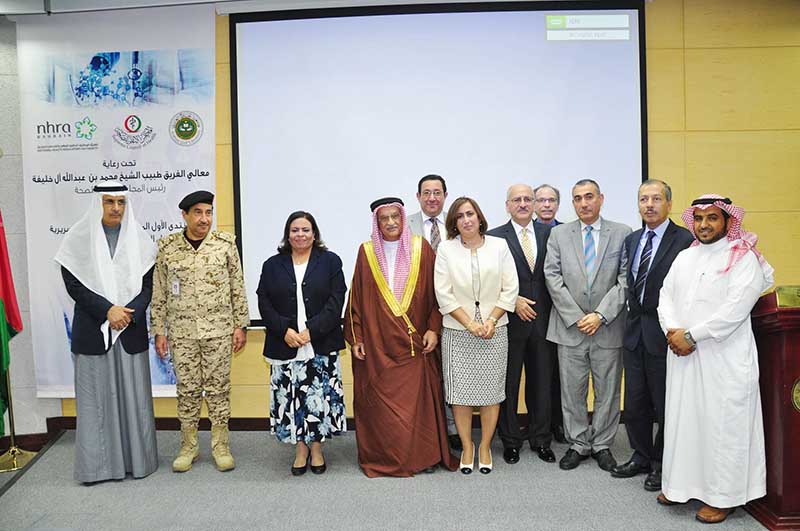
Dr Medhkour was speaking on the sidelines of the National Health Regulatory Authority (NHRA) and AGU Joint Scientific Forum on Clinical Research yesterday.
The forum was opened by Supreme Council for Health (SCH) president Dr Shaikh Mohammed bin Abdulla Al Khalifa and NHRA chief executive Mariam Al Jalahma.
Experts present at the forum discussed the country’s first set of such guidelines, which are expected to be finalised next month.
“Today was the first time Bahrain developed regulations that govern the planning, execution and reporting of clinical trials or research on human subjects,” Dr Medhkour said.
“We already had a trial finish recently on diabetes and another on sickle cell disease, which we have just started.
“We’re testing a new product to help patients with episodes of pain that they encounter.
“We do have a demand in Bahrain from different institutions and companies, asking to conduct clinical trials in our hospital here in Bahrain.”
The final draft of the regulations has now been handed over to the SCH, pending review and feedback.
“This regulation is now a uniform guide,” said Dr Medhkour.
“Where once the NHRA authorised the trial, different hospitals will review the study in a uniform way and this is one of the points of the workshop that took place after the opening ceremony.
“We want ethics committees of different hospitals to have a uniform process (to determine) what is expected in responsible conduct and protecting human rights.
“The final draft was submitted to the SCH for review and now submitted for comments by different
stakeholders.
“They have a 30-day period to provide comments, after which it will be turned into effective regulation and be enforced.”
The regulations cover the quality and manufacturing processes for pharmaceuticals and protection of human research subjects in clinical trials, including informed consent and monitoring.
laala@gdn.com.bh
&uuid=(email))