

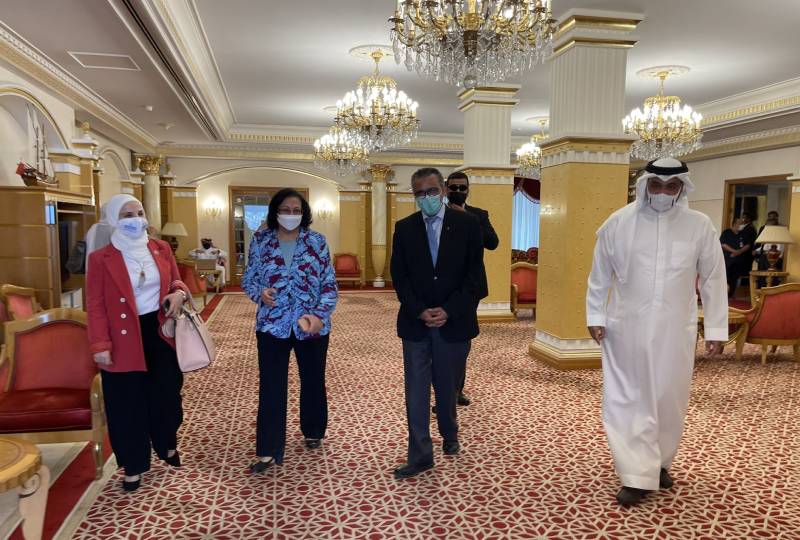
World Health Organisation (WHO) Director General Dr Tedros Adhanom Ghebreyesus has arrived in Bahrain to open the UN agency’s new regional office and celebrate the kingdom’s status as a leading centre of public health expertise.
Dr Ghebreyesus’s visit comes as Manama was recently awarded the title of 'Healthy City 2021' by the WHO. The city has been recognised for its commitment to creating an environment conducive to human well-being, the first Middle East capital to earn the distinction.
He said he was ‘pleased to arrive in Bahrain ahead of the inauguration'. “Our mission is to promote health, keep the world safe and serve the vulnerable everywhere. I look forward to strengthening our collaboration and efforts,” he tweeted after retweeting the GDN post announcing his trip.
Dr Ghebreyesus has been accompanied by WHO regional director for Eastern Mediterranean Dr Ahmed Al Mandhari on his two-day visit to Bahrain to officially open the WHO office.
The establishment of the office in Manama will further develop an already close working relationship between Bahrain’s government and the WHO.
The WHO’s presence in the kingdom will facilitate the collaboration between authorities to ensure that the experience in Bahrain can be shared with others more easily, especially on actions taken to combat the Covid-19 pandemic most effectively.
The director general was met on arrival by Health Minister Faeqa Al Saleh; Under-Secretary Dr Waleed Al Manea, who is a member of the National Taskforce for Combating the Coronavirus (Covid-19); and WHO representative and head of its office in Bahrain Dr Tasnim Atatrah.
He will tour the kingdom’s Covid-19 vaccination and testing facilities, where he will be briefed on measures taken to protect the health of citizens and residents.
Pleased to arrive in #Bahrain 🇧🇭 ahead of the inauguration of the new @WHO Office in 🇧🇭. Our mission is to promote health, keep the world safe and serve the vulnerable everywhere. I look forward to strengthening our collaboration and efforts.
— Tedros Adhanom Ghebreyesus (@DrTedros) July 25, 2021
The tour gives Dr Ghebreyesus a first-hand opportunity to inspect Bahrain’s vaccination infrastructure, which has inoculated more than 70 per cent of the population, a feat which was described by Dr Atatrah as a 'momentous achievement’.”
Last summer, Dr Ghebreyesus praised Bahrain’s virus strategy in a letter sent to Ms Al Saleh, commending the kingdom’s holistic response to the pandemic and its proactive efforts to establish the necessary testing and healthcare infrastructure.
The WHO director general also praised the manner in which Bahrain’s government co-operated with the WHO to monitor the development of the pandemic and to take necessary action in a timely manner.
He will tomorrow open Bahrain’s WHO office, which is set to be led by Dr Atatrah, who recently presented her credentials to the Health Minister and assumed office at the start of June.
Earlier this month, Dr Atatrah praised the Bahraini citizens, residents and the government’s efforts during the pandemic and attributed the successful vaccination campaign to ‘the county’s farsighted leadership’.
The opening of the WHO office in Manama and the appointment of Dr Atatrah serves as the next step in the city’s development as a global centre of health research, practice and innovation. A Press conference has been scheduled tomorrow to allow Dr Ghebreyesus an opportunity to comment on the WHO office’s opening and Bahrain’s efforts to address the Covid-19 pandemic.
The acclaimed Ethiopian biologist, public health researcher and official has served since 2017 as director general of the global health watchdog. One year after Dr Tedros’s election, WHO member states adopted a five-year-strategic plan with an emphasis on delivering a measurable impact in countries, to support countries in attaining the health-related targets in the UN’s Sustainable Development Goals.
WHO’s work was built on a new mission statement, to “Promote health, keep the world safe and serve the vulnerable”, and the ambitious ‘triple billion’ targets: one billion more people benefiting from universal health coverage; one billion more people better protected from health emergencies; and one billion more people enjoying better health and well-being.
To enable WHO to support countries to deliver on these targets, and in close consultation with WHO’s regional directors, Dr Tedros led the development of a new operating model, aligning the new structures and ways of working, and across the three levels of the organisation – headquarters, regional offices and country offices.
“Our vision is not health for some. It’s not health for most. It’s health for all: rich and poor, able and disabled, old and young, urban and rural, citizen and refugee. Everyone, everywhere,” he added.
&uuid=(email))