

Lebanon needs to address the actions of Iranian-backed terror outfit Hizbollah to repair rifts with its Gulf allies.
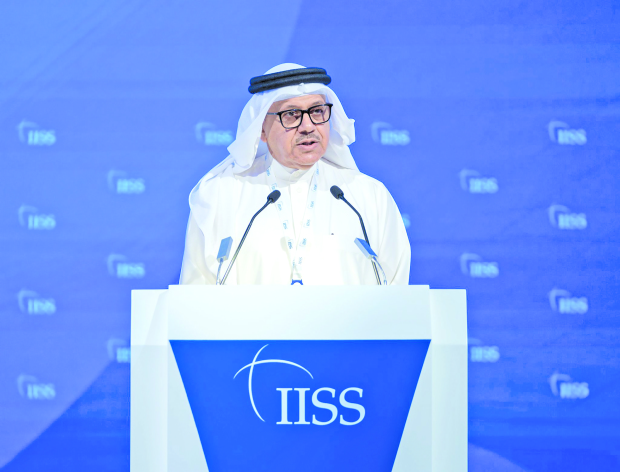
This was highlighted yesterday by Bahrain’s Foreign Minister Dr Abdullatif Al Zayani in his remarks at the 17th Manama Dialogue.
His comments come as Lebanon faces a diplomatic crisis with Gulf states triggered by Lebanon’s newly-appointed Information Minister George Kordahi’s comments about the Saudi-led intervention in Yemen.
They prompted Saudi Arabia, Bahrain and Kuwait to expel Lebanon’s diplomats and recall their own envoys.
Dr Al Zayani said the issue was now more about internal diplomacy. “The issues need to be resolved within Lebanon,” he said.
“We can extend support and try to find solutions in the future – but the country has to demonstrate that Hizbollah can change its behaviour,” he said. “It is a challenge for the Lebanese to really look into changing their policy with Hizbollah.”
On Yemen, Dr Al Zayani noted that the initial objective of the GCC was to help the country prosper. “We got to the point where it was really on a very peaceful path with the support of the GCC countries. Unfortunately, that was undermined by the Houthis and, with the support of Iran, the whole process was jeopardised.”
Dr Al Zayani was addressing the third plenary session of the 17th edition of the regional summit on Diplomacy and Deterrence at the Four Seasons Hotel Bahrain Bay.
He called for ‘neighbouring collective diplomacy’ based on logic and data rather than seeking the path of war.
“That’s the tool which will create different kinds of security and we need a collective security,” he added.
“We cannot talk about security of one of the countries in the region without talking about the collective security. We need to have dialogue. That’s why we initiated and invited our neighbouring countries to Baghdad and we are hoping to continue this method in the future.
“To deal with the internal conflicts in Lebanon and Syria – in many other countries in the Middle East – we need to come together and manage the issues.”
On the Abraham Accords, Dr Al Zayani clarified its aims and objectives. The peace agreement was signed in September last year by Bahrain, the UAE and Israel.
Officials from the two Gulf countries have visited Tel Aviv and vice-versa with a series of economic agreements signed focusing on security, flights, tourism and investments.
“The Abraham Accord is a path of peace not only between the countries – we hope with time that peace will spill over to the whole region,” he said. “We have millions of young people in the region who are deprived of education, health, food, water and shelter – their parents have been separated or lost for years.
“Should we continue on the same path or should we explore avenues where we can give people hope at the end of the tunnel? Hope, that they can live in peace and we can have an interconnected, interdependent stable region.”
He acknowledged that the ‘bedrock’ of the process will be resolving the Palestinian issue, which he said was based on a two-state solution.
Dr Al Zayani concluded with remarks that hope must be injected into communities in the post-pandemic era.
“There is one lesson that Covid-19 taught us – the need for co-operation and that we need to coexist together,” he added.
raji@gdn.com.bh
&uuid=(email))