

THERE has been a drop in the number of domestic violence cases reported in Bahrain last year, a new report has claimed.
However, this has been attributed to the coronavirus (Covid-19) restrictions, making it harder for victims to report domestic violence and social distancing making in-person consultations infeasible.
A study by the Bahrain Young Ladies’ Association (Al Nahda) found that the number of cases reported dropped from 120 in 2019 to just 65 last year.
The highest number of cases registered was 122 in 2018, while overall 1,480 cases have been documented from 1997 until last year.
“To mark International Day for the Elimination of Violence Against Women last month, we wanted to compile statistics obtained from several organisations under the association, each of which provides different services,” association secretary Nadia Al Maskati told the GDN.
“Our latest publication documents domestic violence-related cases where victims approached us for consultative, psychological and legal support,” she added.
Established in 1955, Al Nahda aims to empower Bahraini women and girls.
“The association’s vision is to advance Bahraini women, and part of it is to shed light on the subject by creating a useful source of information and laying down support infrastructure for women,” said Ms Al Maskati.
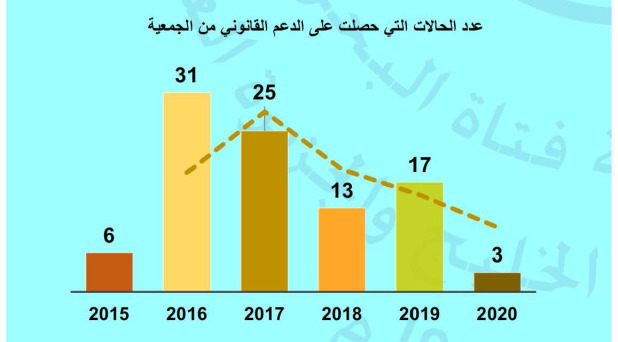
The number of women and girls who received legal support from the association
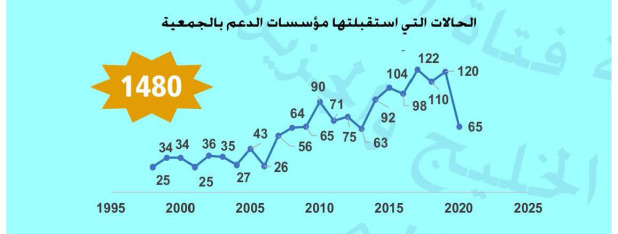
Cases documented by Al Nahda from 1997 until last year
Support
Among the statistics was a breakdown of emotional, physical, sexual, economic and legal abuse cases, subsequent case follow-ups, and cases that received legal aid.
Between 2019 and 2020, all types of abuse recorded from reports by victims almost halved.
Social support case follow-ups declined as follows: incoming calls fell from 711 to 357, outgoing calls from 800 to 562 and in-person meetings from 591 to 113.
As for psychological support, incoming calls fell from 353 to 201, in person-meetings from 270 to 65, but outgoing calls remained almost unchanged.
Moreover, total legal consultations for divorce, child support and custody issues fell from a yearly average of 110 cases between 2015 to 2019, to only 12 in 2020.
“The drop in numbers can be attributed to the pandemic,” explained Ms Al Maskati.
The GDN last year reported a spike in domestic abuse cases in Bahrain in the months following the start of the pandemic.
This global surge was dubbed a ‘shadow pandemic’ by the UN, noting that Covid-19 has exacerbated risk factors for violence against women and girls.
Furthermore, the report lists several challenges in addressing domestic violence, citing the difficulty to ask for help, limited support options, stigma and the subject’s lack of recognition as a national issue in Bahrain.
Among the several steps proposed to strengthen support systems were to open women’s shelters, provide comprehensive mental health services and instate rehabilitation programmes for victims and their children.
As for the recognition problem, the report proposes conducting more studies and creating a national database to track cases.
“We are addressing the lack of statistics by creating our own report, helping inform measures and policies of governmental and civil organisations,” said Ms Al Maskati.
The report stressed the need for policy reforms and new legislation to protect women and girls, with two major recommendations: First, to repeal penal code article 353 which exempts rapists from prosecution if they marry their victims, and, second, to amend the Bahraini Citizenship Act to allow Bahraini mothers to pass citizenship to their children.
“Bahrain must continue abiding by international agreements and follow the Supreme Council for Women’s National Strategy to Protect Women from Domestic Violence,” concluded the report.
zainab@gdn.com.bh
&uuid=(email))