

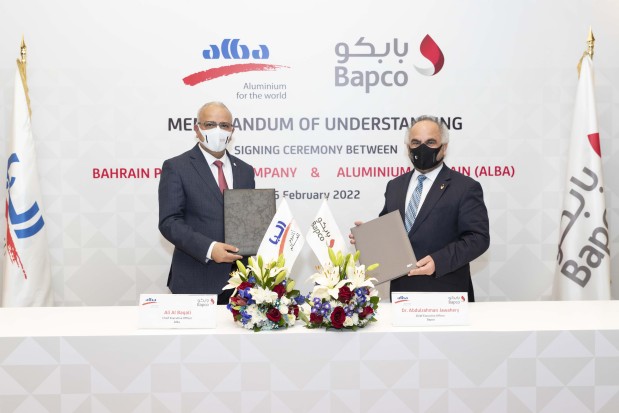
MANAMA: Two of Bahrain’s industrial giants, Alba and Bapco, have joined forces to collaborate on projects that would contribute to the kingdom achieving net zero carbon emissions by 2060.
This follows the signing of a memorandum of understanding (MoU) by Alba chief executive Ali Al Baqali and Bapco chief executive Dr Abdulrahman Jawahery, which will set the platform for a feasibility study on Bapco making surplus hydrogen available to Alba and also enable the formation of a joint taskforce to implement the agreed objectives.
The two companies have also agreed to carry out due diligence for projects of common interest that are in line with commitments made by HRH Prince Salman bin Hamad Al Khalifa, the Crown Prince and Prime Minister, at the 26th United Nations Climate Change Conference of the Parties (COP26) in Glasgow.
“An alliance of this kind, between two of the largest companies in Bahrain, is a commitment to join our forces to embrace sustainable industrial development as we race to meet Bahrain’s net zero emissions by 2060,” commented Mr Al Baqali, adding that, as HRH Prince Salman has shown, uniting efforts was necessary to make a difference, and address climate change by “building resilient infrastructure for a greener and sustainable future”.
Starting as a 120,000 tonnes per annum smelter in 1971, Alba, today, is the world’s largest aluminium smelter ex-China with a production of more than 1.561 million metric tonnes per annum (2021).
To be released soon, the Alba Sustainable Strategy is based on integrating Environment, Social, Governance (ESG) issues in everything the company does and will emphasise efforts towards reducing GHG emissions, promoting efficient resources and waste management across its value-chain.
A testimony of Alba’s sustainability roadmap are projects like the $37.5 million zero-waste Spent Pot Lining Treatment Plant, the upcoming +5MW solar farm project and a strategic role in the future Aluminium Downstream Park.
Describing the MoU as one of many initiatives by Bapco in pursuit of Environment, Social and Governance (ESG) objectives, Dr Jawahery said: “This partnership translates into action our intention to address climate change challenges under the strategic guidance of Shaikh Nasser bin Hamad Al Khalifa, HM the King’s Representative for Humanitarian Works and Youth Affairs and chairman of The Oil & Gas Holding Company as well as the directives of Bapco chairman Abdulla Al Zain.”
Wholly-owned by the government, Bapco currently owns a 267,000 bpd refinery, along with storage facilities for 14 million barrels and marketing and marine terminals for its portfolio of petroleum products.
The ongoing Bapco Modernisation Programme (BMP) will expand the processing capacity to 380,000 bpd.
Strategic objectives of the BMP include improving energy efficiency and lower the Energy Intensity Index (EII) of the refinery by installing new efficient crude and process units.
The project has also targetted a reduction in emissions of air pollutants like sulphur dioxide and nitrogen oxides and in treated wastewater discharge.
Pledging to lead by example, HRH Prince Salman had told COP26 that the kingdom would cut carbon emissions by 30 per cent by 2035.
He also said Bahrain would quadruple its mangrove coverage, double the number of trees and directly invest in new carbon capture technologies.
avinash@gdn.com.bh
&uuid=(email))