

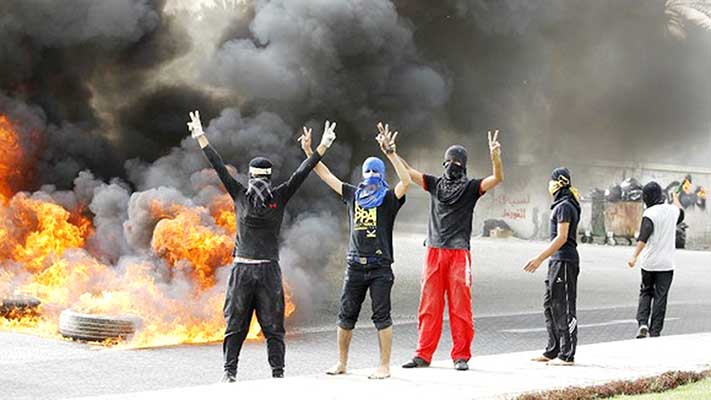
Ronald E Neumann’s ‘Bahrain Slides Back’ is full of diplomatic double talk and sly innuendos. It legitimises a rise of violence in Bahrain and criticises those who work hard to prevent it. As a former ambassador and as the president of the American Academy of Diplomacy one could expect that he would be supportive of the foreign policy that continues to strive for a “Greater Middle East”.
Please accept my apologies if I sound harsh, but I am not a trained diplomat, hence, I can only speak the truth and as a long-time observer would like to expose the absurdity of this recent article and others who make every effort to slander and divide the government of Bahrain.
The article starts with a suggestion that continuous unrest has a destructive effect on the economy and draws criticism from Bahrain’s allies – perhaps a valid statement on not so ideal yet very common scenario applicable to many nations. However, the assertion that to achieve true democracy, there should be a mechanism of “losers to become winners” suggests that the preferred course for the country is to maintain a status quo and allow the weakened opposition to gain access to policy-making, and only then will Washington consider Bahrain a democracy. In fact, the assertion that democracy is a path for losers represented by opposition in Bahrain to become winners simply violates plurality of vote and attempts to skew elections. When accusing the government of carrying out “coercive” acts against its voters, Newmann appears unaware of the time honoured democratic precept of voter-fraud. How does this renowned diplomat suggest that the government of Bahrain should ignore the majority vote only to score a sympathetic nod from Washington?
Let’s face it, when Neumann speaks about the Secretary of State John Kerry’s attitude towards Bahrain, the objective is to facilitate the losers of the opposition to become winners. There is obviously nothing “low-key” about any meeting between nation-state diplomatic representation and the leadership of the insurgency. Such acts legitimise opposition violence and blatantly violate Bahrain’s sovereignty. One can only surmise that such “low-key meetings” are an open act of provocation in America’s multidimensional game of politics.
Neumann goes on to suggest that Bahrain has a fear of Iran – he has obviously disregarded Iran’s irrational interference across the globe, the threatening of neighbours’ sovereignty, and export of terrorism. How did he overlook that Mushaima stood at the GCC roundabout in 2011 and announced the “Islamic State of Bahrain”? One also wonders if the payment by Obama of $400 million in ransom for the release of four Americans held hostage in Iran is a manifestation of that same fear! The article has failed to acknowledge the influence and grip over Al Wefaq by Khamenei in Iran. In fact, the dismantling of Al Wefaq has now provided Bahrain with an ideal opportunity to hold constructive dialogue with political parties interested in compromise and the well-being of Bahrain. It is surprising that a man of Neumann’s credibility would mislead readers.
Neumann supports his lack of moral core on the matter when he writes: “Suppressing Al Wefaq is likely to push at least some of its supporters into closer ties with more radical factions”. Does he not consider Al Wefaq’s armed militia, Feb14 coalition/Tamarood Movement/Al Ashtar Brigade to name a few which target security personnel and expatriate workers “radical factions?”. It is a well-known fact that Iran and Hizbollah have been meddling in the GCC’s affairs for decades. To create unrest in Bahrain, Al Wefaq selected youth financed by Iran for training in Hizbollah guerilla warfare in Iraq, Iran and Syria. Despite all the obvious evidence, voices like Neumann insinuate that witnesses and victims are insignificant. How dare he show such indifference to the deadly actions of armed militia that have taken the lives of 19 unarmed policemen with homemade incendiary devices? Why has he failed to question the source of $10m in one of Isa Qassim’s bank accounts? Why does he not question Al Wefaq for not demanding an end to armed militia who publish videos claiming responsibility for terrorist acts? The least Neumann could say is the same actions would be labelled as terrorism and occupation in the West.
When a court representative went to deliver summons to Isa Qassim, the men stationed outside his home threatened: “The only way you will enter is over our dead bodies!” Was it not Isa Qassim who told his followers to “crush the police”? Some have left their jobs to be stationed outside Isa Qassim’s home. Who is paying their salary now? Can these men and women be trusted in the future to respect the law and act for the benefit of all people in Bahrain?
The US administration’s miscalculated assessment could have resulted in a tragic outcome for Bahrain. Look at Iraq, Syria, Yemen and Libya – these countries have become a sectarian bloodbath. In Iraq, Washington assumed by removing Saddam Hussein they could establish “democracy”. However the deepest error was that America did not and does not understand Arab society or its complexities. Occupation in Iraq was despised throughout the Middle East and today over a decade later there are in excess of 740,000 widows, over 4.5m homeless and over 1m dead, 90 per cent of which are civilians. On hindsight, intellectual voices now preach about the stability in Iraq under Saddam. Washington’s policy emphasises the intention to remove Sunni leadership, divide the region and maintain control through sectarian violence.
Is this the “democracy” planned for “Greater Bahrain”?
Bahrain’s head of government has maintained a strong stance, but all must be aware of the dangerous liaison between actors in the West and opposition sympathisers entrenched within the system or with friendly links that may have limited access and others with in-depth knowledge.
Articles or reports by learnt people have intensified a campaign targeting the head of government to achieve an internal collision or divide through information warfare. So far they have failed. However, it is imperative that Bahrain is vigilant and maintains a united position to ensure enemies and destructive messages are chastised.
Sally Saar
&uuid=(email))