

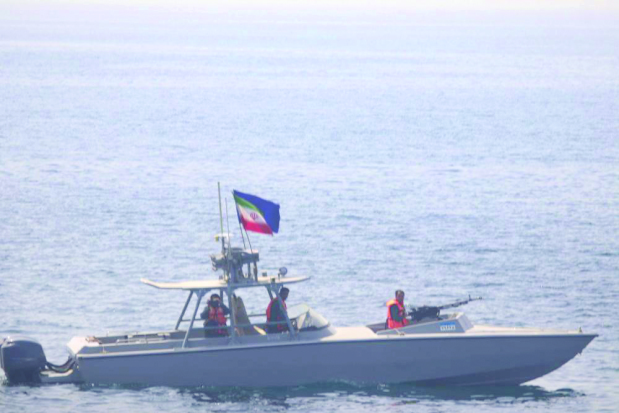
AMERICAN and Iranian naval vessels had a near-miss encounter in the strategic Strait of Hormuz on Monday, according to the Fifth Fleet.
Three armed fast speed boats belonging to the Islamic Revolutionary Guard Corps (IRGC) zipped past USS Sirocco and expeditionary fast transport ship USNS Choctaw County, and nearly caused a crash.
A third of the world’s liquefied natural gas and almost 20 per cent of total global oil consumption passes through the strait, making it a highly important strategic waterway for international trade.
Tensions
The tense, mid-sea close encounter comes as tensions remain high over stalled negotiations over Iran’s tattered nuclear deal with world powers and as Tehran enriches uranium closer than ever to weapons-grade levels under decreasing international oversight.
According to the Juffair-based Fifth Fleet, the US vessels were on a routine transit through the strait when the three Iranian boats approached USS Sirocco head-on – coming within 50 yards of the USNS Choctaw County and diverting only when audible warning signals were issued and a warning flare deployed.
“One of the Islamic Revolutionary Guard Corps Navy (IRGCN) vessels approached Sirocco head on at a dangerously high speed and only altered course after the US patrol coastal ship issued audible warning signals to avoid collision,” said in a statement yesterday.
“The Iranian vessel also came within 50 yards of the US Navy ship during the interaction, and Sirocco responded by deploying a warning flare.”
The interaction lasted an hour, and ended when the IRGCN craft left the area.
“US Navy ships continued their transit without further incident.
“The IRGCN’s actions did not meet international standards of professional or safe maritime behaviour, increasing the risk of miscalculation and collision.”
The Fifth Fleet added that the US naval forces continue to ‘remain vigilant’ and will continue to “fly, sail and operate anywhere international law allows while promoting regional maritime security”.
Incidentally, in 2016 Sirocco intercepted a stateless dhow carrying a large cache of weapons, including 1,500 AK-47s, 200 RPG (rocket-propelled grenade) launchers and 21.50-calibre machine guns.
The weapons originated from Iran and were bound for Yemen.
The last similar interaction between the US and Iranian vessels took place on March 4, when three Iranian navy vessels approached USCGC Charles Moulthrope, USS Dextrous, USS Devastator and USNS Wally Schirra which were transiting through the strait.
Warning flares were deployed by the two US Navy ships to end the nearly two-hour stand-off after issuing multiple warnings via bridge-to-bridge radio.
In May last year, a US Navy ship was forced to fire 30 warning shots after a flotilla of 13 Iranian navy boats harassed six US vessels transiting the strait. The GDN previously reported that in 2016 there were 35 ‘unsafe and unprofessional interactions’ between US and Iranian naval forces, and 23 in 2015.
The Fifth Fleet’s area of operations encompasses about 2.5 million square miles and includes the Arabian Gulf, Gulf of Oman, Red Sea and parts of the Indian Ocean.
It also covers three critical choke points at the Strait of Hormuz, the Suez Canal and the Strait of Bab Al Mandeb at the southern tip of Yemen.
sandy@gdnmedia.bh
&uuid=(email))