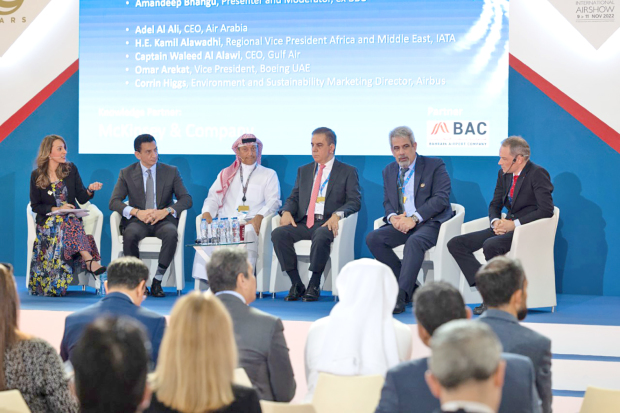
AIR ticket prices are bound to soar as airlines seek to go green, a panel discussion heard yesterday.
Sustainable Aviation Fuel (SAF), touted as a solution to airlines’ efforts to be eco-friendly, is expensive and the burden could be passed on to the passengers, said Gulf Air chief executive Captain Waleed Al Alawi.
He urged governments to work together to find solutions to this problem which would otherwise “hurt the industry”.
“I believe that immediate action by the entire world is required to reorganise our routes,” he said, pointing out how the Russia-Ukraine conflict had impacted flights.
“A flight that used to take about four-and-a-half hours is now taking six-and-a-half hours. But if you could fly from London without zigzagging to Bahrain there’s about 20 per cent saving on fuel.”
Capt Al Alawi was speaking during “The Path to Net Zero” panel discussion on the sidelines of the Bahrain International Airshow (BIAS) 2022 at the Sakhir Airbase.
Aviation industry leaders discussed the need to adapt to the new normal to achieve more sustainable and inclusive growth.
Capt Al Alawi also discussed the challenges of SAF which experts say is the “way forward” in the industry’s quest for net zero emissions.
SAF is a biofuel used to power aircraft that has similar properties to conventional jet fuel but with a smaller carbon footprint. Depending on the feedstock and technologies used to produce it, SAF can reduce greenhouse gas (GHG) emissions dramatically compared to conventional jet fuel. Some emerging SAF pathways even have a net-negative GHG footprint.
Capt Al Alawi said SAF was expensive, and lowering fuel prices may result in higher ticket prices.
“We used SAF to fly for Formula One and it proved three to four times more expensive.
“On one hand, we try to save, and on the other, we are expected as an airline to take the burden off the fuel costs, which means we have to kind of transfer the majority of it to the ticket prices.”
“We have to look after the passengers and we want them to fly because that’s the core of our business.
“Realistically, we need all the governments worldwide to support this effort to make travel at reasonable financial cost for the passengers – otherwise, we’re going to hurt the industry.
“And if we are hurt as an airline, the manufacturer will be hurt and all the supporting industry will be hurt as well.”
Meanwhile, International Air Transport Association (IATA) regional vice president Kamil Alawadhi said passengers were understanding despite knowing little about behind-the-scenes problems.
“Movement requires a lot of arrangements by the aviation industry – whether it’s manufacturing, airlines or airports. The passengers actually know very little about what it takes to make that happen; it’s a complex system.
“But passengers today are a lot more conscious about the environment than they were 10 to 15 years ago and they are willing to participate and pay the higher price of tickets.”
Air Arabia chief executive Adel Alali felt that the customers were happy, hoping that the show will go well in the future. He also noted that travel of a personal nature has come back post-pandemic.
“During the pandemic, there was a lack of demand and now there is a lack of supply.
“Then, nobody wanted to travel and now everybody wants to travel, but the issues today are delayed delivery of aircraft because of logistics and supply issues and pilot shortage.”
Also taking part in the discussion were Boeing UAE vice president Omar Arekat and Airbus’ Environment and Sustainability marketing director Corrin Higgs.
raji@gdnmedia.bh